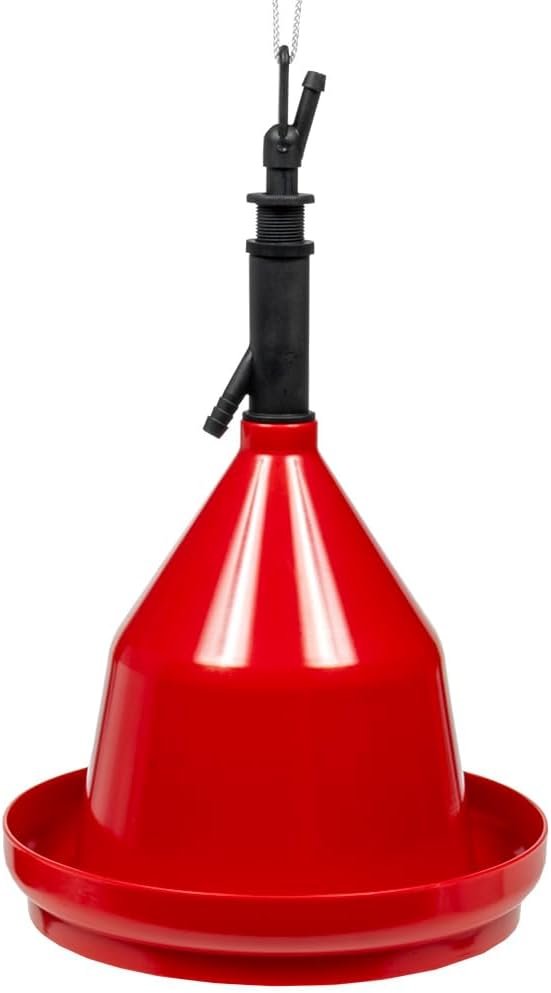
An automatic chicken waterer needs a supply matched to its exact valve and instructions. Some founts require a stated operating-pressure range; some bells refill from a low-pressure elevated tank or bucket. A hose that fits is not proof of compatibility. Map the source, connecting parts, valve and drinking point before ordering, and distinguish automatic trough filling from the separate job of refilling the reservoir.
We may earn a commission when you buy through links on this page.
Start at the source rather than the bowl
Describe where the drinking water will come from. Is there a proposed connection to a property water supply, or will someone fill a separate reservoir? Where can that source be reached, checked and isolated? These answers determine much of the system that is absent from a product photograph.
A bucket-fed bell can refill its trough automatically while the bucket still needs manual refilling. Conversely, a connected line can continue supplying a failed valve until the supply is isolated. Neither arrangement removes the need to check operation, water availability and actual drinking access.
Our automatic-waterer comparison separates these supply arrangements and identifies model-specific limitations. Use it after naming the source. If carrying and filling a reservoir remains acceptable, the broader chicken-waterer comparison can help compare complete formats without assuming that a permanent connection is necessary.
Map the complete water route
Match the valve's supply conditions
Miller’s current linked 2500-series fount instructions state a 20–50 psi operating range for those valves. The document covers the 2500, 2525 and 2550 family. That is a product requirement, not a pressure recommendation for every poultry waterer.
The same document describes the fount mechanism as operating on a gravity basis and requires the unit to be suspended plumb. Do not read that phrase in isolation as approval to feed it from any low-head bucket. The stated supply range and the mechanical mounting directions both apply to that family.
If the proposed source cannot meet a product’s applicable conditions, resolve the complete supply design with the manufacturer and a qualified installer before buying fittings. Do not select an arbitrary reducer or change the source merely because the connection can be made physically. No universal pressure setting is supplied by this guide.
Understand what an elevated reservoir changes
Premier’s Suspended Dome Drinker is documented as a low-pressure gravity-flow arrangement. Its current assembly and troubleshooting instructions show a separate bucket, tubing and the suspended drinking unit. The source and supply hose must be positioned for the maker’s gravity arrangement; the photographed dome is not itself the storage reservoir.
Premier identifies 3/8-inch tubing for this model and lists the reservoir, hoses and connectors as separate purchases. That does not approve tubing of any size, any reservoir height or any direct connection to household pressure. Confirm the complete model-specific arrangement rather than borrowing a setting from another bell.
The separate source also needs a practical refill route. Imagine a bucket positioned where gravity flow works but the caregiver cannot conveniently inspect or refill it. The waterer may be mechanically connected while the care plan remains incomplete. Record who fills the source and how its actual contents and condition will be checked.
See the separate reservoir and drinking point
The manufacturer video below is useful for seeing the Premier dome, supply tubing and external bucket as different components. It is a demonstration of that product, not evidence that the arrangement fits another bell or the pressure-fed Little Giant fount family.
Use the current written instructions for the exact delivered model. Do not copy a hole size, adapter choice, mounting detail or adjustment across brands merely because a video shows a red bell. The purpose here is to make the water route visible before specifying the complete project.
Record each connection separately
Write down the connection at the source, the connecting line and the waterer’s inlet. Miller’s fount-series directions identify a separate adapter for a garden hose; a half-inch pipe-thread description is not interchangeable with a garden-hose connection. Premier’s reservoir-fed tubing is another arrangement again.
Then identify what the exact purchase includes. A pictured hose may be supplied with one model and optional for another. An adapter, guard, reservoir or suspension component that appears in an accessory list should stay on the separate-purchase list until the selected package confirms it is included.
Use components specified for the intended drinking-water system and its actual operating conditions. If the plan connects to a property water supply, ask the provider or qualified installer to determine the applicable source-protection and backflow arrangements. This article specifies no local plumbing code, universal protective device or installation sequence.
Support and access belong on the supply plan
Mark how the waterer and its source will be supported under the exact instructions. A suspended fount’s operating arrangement should not be replaced with an improvised resting position just because the bowl appears level. Similarly, a separate tank’s filled condition must be considered in the actual installation plan rather than estimated from the empty container’s appearance.
Keep the source, drinking surface, isolation point and service parts accessible. If another housing purchase is involved, the coop-format comparison helps distinguish the occupied compartment from the service route. Overall advertised building size does not establish a suitable support or mounting location for a water system.
Premier’s instructions identify an in-line filter that can clog. A full reservoir with an obstructed flow path can therefore leave the drinking point without water. Plan how the specified filter and valve can be reached and serviced before placing other equipment around them.
Check flow regulation and drinking access separately
Follow the exact product’s setup directions to establish that the assembled arrangement receives water and regulates or stops flow as intended. Observe the connections and drinking point. The presence of water in a trough is an observation of the equipment at that time, not proof that the supply will remain fault-free.
Separately observe the actual birds’ ability to reach and use the waterer. Bowl geometry, an activation mechanism and the location all matter to that task. This article provides no brooding protocol, universal mounting height or fixed flock capacity derived from the reservoir’s volume.
Keep another working water source available while a fault is investigated or equipment is serviced. An unusually wet patch, unexpectedly low reservoir or empty drinking point should trigger inspection of the route under the maker’s directions. None alone proves a particular failed part or establishes how much the birds drank.
Include seasonal conditions and routine cleaning
A connected line, reservoir, valve and drinking point are separate components with their own applicable limits. Check the exact manufacturer’s seasonal directions before relying on an arrangement in freezing conditions. Do not infer freeze protection from a large tank, sheltered position or the absence of electrical parts.
This guide approves no improvised heater, universal winter conversion or additive. If the proposed system cannot be used under the actual conditions, maintain a suitable working water arrangement within the care plan. An automatic label does not turn a seasonal limitation into a problem the birds can be left to solve.
For routine care, CDC's backyard-poultry guidance calls for cleaning poultry equipment outside the home and washing hands after contact with birds or their environment. Follow the exact equipment instructions for disassembly, cleaning and reassembly; no universal chemical concentration or contact time is prescribed here.
Leave the next caregiver a clear record
The finished record should name the water source, exact drinker, applicable instructions, supply conditions, connections and separate components. Add the refill route, isolation point and service contact. Mark any unresolved pressure, package or support question before ordering instead of treating a blank field as approval.
For handover, distinguish source checks from drinking-point checks and bird access. A caregiver should know which reservoir needs refilling, where a fault can be isolated and which instructions apply. No reservoir volume, advertised bird count or connected hose establishes a safe interval without care visits.
Common questions
Can any automatic chicken waterer run from a raised bucket?
No. Match the exact valve's documented supply conditions. Premier's dome uses a low-pressure elevated-reservoir arrangement, while the Little Giant 2500-series instructions specify a 20–50 psi operating range. The word gravity in a mechanism description does not erase a separate supply requirement.
Does automatic mean the reservoir fills itself?
Not necessarily. A bell or valve can maintain water at the drinking point while its separate source still requires manual refilling. Record what supplies that source, how it is checked and who refills it. Automatic trough filling does not eliminate routine care or guarantee continuing water availability.
Is a hose adapter enough to make the supply compatible?
No. Physical fit does not establish the required pressure, correct thread, acceptable components or appropriate source-protection arrangement. Check the exact model and complete water route with the manufacturer and qualified installer or provider where applicable, rather than choosing fittings in isolation.
Featured product image from the exact Premier 1 Supplies via Amazon listing. The drinker photograph shows the drinking point, not the external water reservoir or a complete installed supply. Original water-route worksheet by Backyard Henhouse.