Choose a treadle feeder by the exact model’s intended birds, their independent ability to operate it and the complete feeding station before comparing storage capacity. A bird that reaches in while another holds the lid open has not demonstrated independent operation. Keep eligibility, opening-weight settings and training hardware as separate checks, and maintain a working feeding arrangement while a transition or equipment problem is resolved. A larger reservoir alone does not establish usable feeding access.
We may earn a commission when you buy through links on this page.
Start with the actual flock
Record the birds that will use the feeder and the exact product conditions that apply to them. A mixed group may include lighter members or birds with different access needs. Do not assess the purchase only from the largest bird or a product photograph showing a hen on the platform.
Our restricted-access feeder comparison separates the mechanism, intended birds and selected package. Use it to compare documented requirements after identifying the flock. It does not supply measured opening forces, a guaranteed training result or proof that a particular model excludes every rodent.
Imagine a lighter flock member feeding beside a heavier bird that operates the platform. That observation can show access while the lid is already open, but it does not establish what happens when the lighter bird approaches alone. Keep those two observations separate instead of using either as a substitute for the full care assessment.
Three checks before choosing the larger reservoir
Read the exact model's eligibility conditions
The Grandpa's FAQ states 500 grams to open its Standard feeder. We retain the gram figure because the accompanying 14-ounce conversion is inconsistent. It is a manufacturer specification, not an opening-force measurement performed by this site.
That information helps screen the product, but actual independent operation remains a separate observation under the correct setup. Do not reduce the requirement by using an incorrect unit conversion or assume a bird is eligible because a similar family member appears in another listing.
The same distinction applies to intended ages or other conditions. Product wording identifies the manufacturer’s scope; it does not demonstrate that an individual bird has approached, operated and reached the feed. Keep a condition that is not established on the unresolved list before ordering.
Separate eligibility from an adjustable opening setting
Olba’s current Feedomatic manual states suitability for chickens weighing 400 grams or more and then gives model-specific opening-weight configurations. Those are different pieces of information. The minimum suitability statement does not mean that every configuration opens at that weight.
Use the table corresponding to the delivered model. For the 12 kg AF12F, the AF12F/AF20F table applies; another size family’s lighter configuration must not be substituted. This guide provides no universal setting, added-weight method or instruction to modify a linkage to make a bird qualify.
Before selecting an adjustable feeder, confirm that the exact model, applicable instructions and appropriate configuration can be established for the actual flock. A wide adjustment range on a product page does not make every possible combination appropriate. If the conditions cannot be met, compare another documented arrangement.
Treat a weight plate as a model-specific feature
The RentACoop 25 lb manual separately states intended use for full-sized chickens 12 weeks and older and bantams 20 weeks and older. It also describes different weight-plate configurations around three pounds. That is not a universal three-pound minimum for all treadle feeders.
Use the exact supplied instructions to determine the applicable configuration and assess actual operation. Do not treat age alone as proof that a bird can use the feeder, or borrow directions from the brand’s 40 lb product. A similar lid or platform does not establish that the hardware and conditions are the same.
The useful purchase question is whether the intended flock can use the documented arrangement, not whether the page advertises a feature for smaller birds. This article gives no age-based care protocol or hardware-removal sequence; it identifies what needs to be checked before selecting the product.
Check the base, platform and moving parts
Map the proposed feeding station, including the complete platform footprint and service route. Use the exact maker’s setup instructions for the base and mechanism. A reservoir that fits the available corner can still leave insufficient room to approach the treadle, refill the feeder or inspect the moving parts.
Some instructions deliberately require factory-set linkage fasteners to remain free rather than fully tightened. Do not apply an all-bolts-tight checklist indiscriminately. The moving mechanism has to be assembled and maintained under its actual directions, with applicable service points reachable.
If the housing arrangement is still being chosen, the coop-format comparison helps distinguish occupied space from the feeding and service route. Overall advertised dimensions do not establish a usable platform location or the room required around an installed feeder.
Keep normal operation, training and locks separate
Record the feeder’s intended normal state and how the specified training hardware changes it. A lid held open for familiarization is a different arrangement from a normally operating closed-trough feeder. It should not be described as providing the same access restriction throughout that period.
Locks also affect access. Identify the exact lid or mechanism being controlled, follow the applicable directions and keep the care plan clear. A lock fitted to a product does not by itself prove pest exclusion, nor does a locked mechanism demonstrate that the birds have feeding access.
No universal training timetable is prescribed here. A maker’s staged hardware instructions do not establish that every flock learns within a fixed number of days. Do not use hunger to force equipment use; resolve uncertain access within a working feeding arrangement and appropriate flock care.
Observe operation and access as the feed level changes
Check that the assembled equipment operates under the exact instructions, then separately observe the actual birds using it. A moving lid is an equipment observation. A bird independently approaching, opening and reaching feed is another, more specific observation.
Stored feed and reachable feed are also different. A hopper can contain material while the feeding point is affected by an incorrect flow arrangement or an access problem. Use the exact maker’s feed and flow instructions rather than assume a full-looking reservoir settles the question.
If the treadle arrangement cannot be made suitable, the broader chicken-feeder comparison can help evaluate another complete format. A different feeding mechanism may fit the actual task better than repeated attempts to alter an uncertain treadle setup.
Choose capacity after the station works on paper
Once eligibility, configuration, footprint and access are established, compare the selected reservoir capacity with the practical refill and cleanout route. More storage may be useful, but it does not create additional usable feeding positions or change the conditions required to operate the mechanism.
Keep capacity separate from a promised number of days without care. This guide does not calculate an unattended interval from a maker’s bird count or feed-volume claim. The care plan still needs checks of feed availability, actual access, movement and the surrounding station.
Leave a clear record for another caregiver
Keep the exact model, applicable instructions, intended configuration and chosen training hardware with the feeding record. Mark any unresolved access issue and the manufacturer contact. Another caregiver should not need to infer the operating state from a lid position or a photograph.
Record direct observations and changes without converting them into a health or diet diagnosis. If a bird is not feeding or appears unwell, obtain appropriate care help. An equipment adjustment or a larger reservoir does not establish that a feeding problem has been resolved.
Common questions
Does a bird feeding beside another prove it can operate the treadle?
No. Reaching feed while another bird holds the mechanism open is a different observation from independent operation. Assess the exact model's conditions, correct setup and the actual bird's access under the care plan rather than assume one proves the other.
Is a minimum suitability weight the opening weight for every setting?
No. Olba's current manual, for example, states an eligibility condition separately from model-specific opening configurations. Use the table for the delivered model and distinguish that setting from the general suitability statement. This guide provides no universal adjustment recipe.
Should I buy the largest reservoir to make feeding easier?
Choose actual access, compatible configuration and station fit first. A larger reservoir does not prove a lighter bird can operate it, create more usable feeding positions or establish a period without care visits. Compare capacity only within an arrangement that meets the exact product and flock requirements.
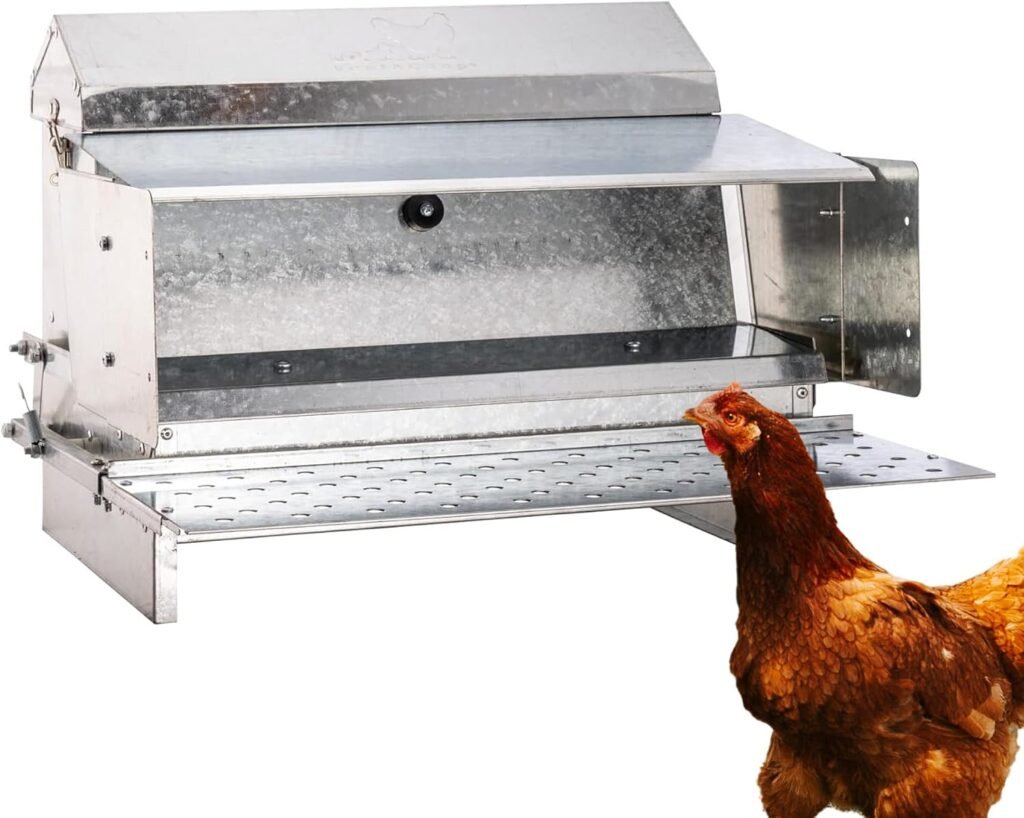
Featured product image from the exact RentACoop via Amazon listing. The photograph is a product-listing illustration of one treadle format. The pictured hen does not establish that a particular bird can operate it or that this site tested the feeder. Original selection worksheet by Backyard Henhouse.