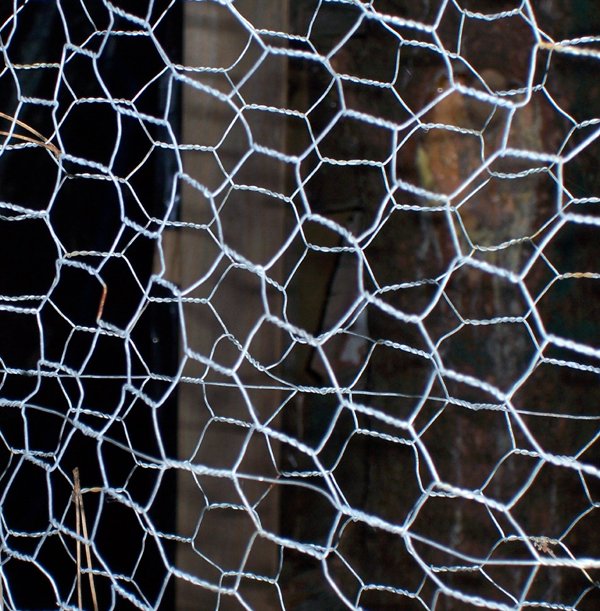
For a chicken enclosure, chicken wire and hardware cloth serve different jobs. Common hexagonal chicken wire can contain birds, while appropriately specified hardware cloth is used for protective screening such as coop vents and openings. Choose the opening size, wire construction, and fastening system for the actual threat. Neither material’s name guarantees a predator-proof enclosure.
We may earn a commission when you buy through links on this page.
Start with the part of the building you are protecting. A vent, a full-height run wall, a roof, and a ground edge are different installations. Comparing two rolls without identifying that job can leave you with the wrong mesh even when both are sold for poultry.
What the names tell you, and what they do not
Chicken wire usually refers to a woven hexagonal mesh. Hardware cloth commonly refers to a grid of wire with smaller openings, often welded. Read the actual listing and specification rather than treating those names as fixed opening sizes or wire thicknesses.
The University of Maryland's housing guidance specifies half-inch hardware cloth over coop windows. That is a particular protective-screening application. It does not say that every half-inch roll will withstand every predator, or that a window specification is a complete design for a large run wall.
The important distinction is the job the barrier must do. Keeping a chicken from walking through a gap is different from resisting an animal pulling at the mesh, reaching through it, or working at its edges. Do not use successful bird containment as your only evidence of protection.
A mesh name is not a complete barrier
Compare five features on the actual roll
First, record the opening size. An inch dimension in the title may describe the mesh opening, the roll width, or another feature. Confirm the specification and units. A smaller opening changes what can pass through or reach through, but it does not strengthen a weak attachment to the building.
Second, record the wire gauge or stated wire diameter and the construction. Gauge and opening size are independent properties. Two rolls with the same opening can have different wire thicknesses and construction. Do not describe all hardware cloth as heavy-duty simply because its squares are small.
Third, check the coating and exposure suitability. Outdoor moisture and damaged edges are maintenance considerations, so confirm the maker’s stated application. We do not assign a universal lifespan to galvanized, coated, or stainless mesh in every climate.
Fourth, plan the fastening and support. A sturdy roll fixed to deteriorated wood or left loose around a frame is not a complete barrier. Finally, inspect the joins, corners, door edges, and ground transition. Those details can leave openings that the mesh in the middle of the panel cannot correct.
Our chicken-coop wire comparison separates opening size, gauge, roll dimensions, and intended application. Use it after identifying the section of the enclosure, rather than buying by the words chicken wire alone.
Match the material to the part of the enclosure
For a coop window or ventilation opening, start with applicable extension guidance and confirm how the protective mesh will be supported and attached. Keep the intended ventilation area functioning; covering a vent with a solid panel is a different change from screening it.
For a run wall, consider the expected loads, support spacing, predator exposure, and complete perimeter. A large wall may need a structural fencing arrangement as well as smaller protective mesh at relevant openings. New Hampshire Fish and Game's chicken-protection guidance is a useful primary reference for thinking beyond bird containment.
For a roof or overhead section, consider overhead access and the structure supporting the covering. Netting, wire, and a solid roof are not interchangeable descriptions. This comparison does not provide a structural design for snow, wind, or animals climbing onto the enclosure.
At the ground, inspect the junction rather than assuming the wall roll answers the digging question. A buried barrier, an apron, and a foundation are different arrangements. Choose an appropriate complete design for the site; do not infer one universal burial depth from a roll’s product name.
Half-inch mesh does not answer every exclusion question
Half-inch hardware cloth is a common coop recommendation, but mouse exclusion can require a smaller opening and additional work at doors and other penetrations. The National Park Service rodent-exclusion manual hosted by Utah State includes quarter-inch hardware cloth in its rodent-exclusion specifications.
That does not turn a quarter-inch roll into a universal answer either. Wire strength, fastening, the animal involved, and the rest of the enclosure still matter. For a particular problem, use the relevant wildlife or extension guidance and inspect all access routes, including spaces that are not mesh panels.
A camera can help you understand activity around a coop, but it does not replace a physical barrier. If monitoring is part of your plan, compare power, coverage, and recording limitations in our coop-camera guide separately from the fencing decision.
Work through a replacement example
Imagine a run with intact hexagonal wire across the wall but a loose bottom edge and a gap beside its gate. Replacing only the center of that wall with smaller mesh would leave two obvious access points untouched. First record the gate gap, bottom attachment, wall supports, and other openings, then choose materials for the complete correction.
In another hypothetical case, a coop vent has a solid wooden frame and no protective screen. That is a much narrower task: measure the opening, select a suitable screen specification, and plan its secure attachment without blocking air exchange. The same roll dimensions needed for the full run may be unnecessary.
These examples are planning exercises, not field tests. If a supplier cannot identify the opening size, wire thickness, and construction, you cannot make a meaningful comparison from its poultry photograph alone.
Inspect after installation and during routine care
Check for loose edges, damaged mesh, corrosion, failed joins, and gaps at moving doors. Include the original frame and fasteners in the inspection. A sound panel attached to a deteriorating structure needs attention just as a torn panel does.
If you are replacing the entire building, our coop comparison considers the enclosure as a system. Treat mesh as one component alongside the walls, doors, roof, ventilation, and site. The decision becomes clearer when each component has an identified job instead of a broad predator-proof label.
Common questions
Is chicken wire the same as hardware cloth?
No. Chicken wire commonly has woven hexagonal openings, while hardware cloth commonly has a smaller grid. Confirm the actual opening, gauge or diameter, construction, and application rather than relying on the name.
Is half-inch hardware cloth enough for every predator and rodent?
No universal guarantee follows from that dimension. Extension guidance uses it for particular coop openings, while rodent-exclusion specifications can require smaller mesh. The attachment and the rest of the enclosure also matter.
Can a stronger mesh roll fix gaps beside the gate?
Only if the whole installation addresses those gaps. Inspect supports, joins, door clearances, the roof, and the ground edge as separate parts of the barrier.
Cover photograph by English Wikipedia, CC BY-SA 3.0, via Wikimedia Commons. Contextual photograph; it does not identify a recommended product or endorse the installation shown. Original planning diagram by Backyard Henhouse.
