Choose a no-waste chicken feeder by the feed-loss problem you can observe and the amount of feed the birds can actually reach. Omlet’s 12 lb manual model has five hooded ports and a documented flow adjuster; Little Giant PHF11 uses a divided pan, lip and adjustable feed level. RentACoop offers a mounted single port or a grated trough, while OverEZ provides three front ports and a larger reservoir. These are different ways to present feed, not proof that any selected model produces zero waste.
We may earn a commission when you buy through links on this page.
Our picks at a glance
Start with the features that fit your setup.
Five hooded ports with a documented feed-flow adjuster
Omlet No Waste 12 lb Feeder

The current manual starts with the adjuster installed and explains when to remove it for more flow. Restricting exposed feed is not the same as proving birds can reach enough.
- Feeding surface
- Five hooded feeding ports
- Selected format
- Selected manual 12 lb format
Open divided pan with an adjustable feed level
Little Giant PHF11 Hanging Feeder

The pan keeps feed visible and its level can be adjusted. It remains an open feeding surface rather than a hooded-port or pest-exclusion system.
- Feeding surface
- Circular divided open pan
- Selected format
- Maker PHF11, 11 lb format
Also in this guide
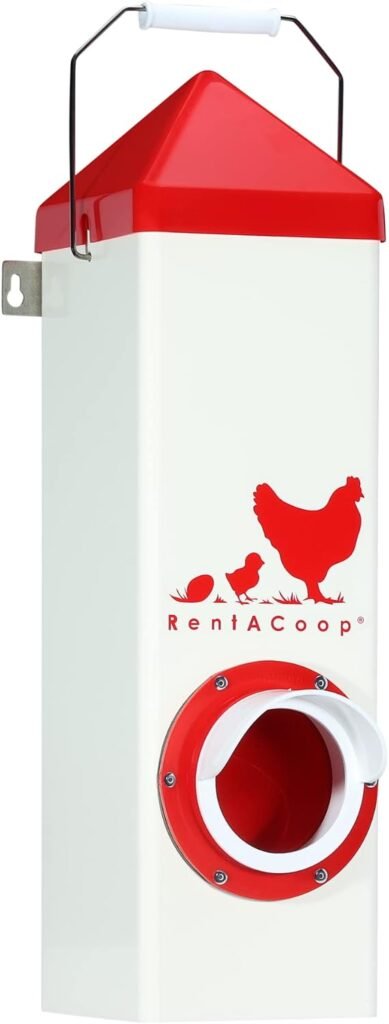
- RentACoop 10 lb High-Rise Single-Port FeederMounted single covered-port format
- RentACoop 25 lb Metal Trough FeederFront trough with a grate that can be stowed for access
- OverEZ Classic 50 lb FeederLarger floor-standing reservoir with three front ports
Feed-presentation features compared
| Product | Feeding surface | Selected format | Loss-related feature | Access condition |
|---|---|---|---|---|
| Omlet No Waste 12 lb Feeder | Five hooded feeding ports | Selected manual 12 lb format | Included removable Feed Flow Adjuster | Current instructions preserve flow and actual access |
| Little Giant PHF11 Hanging Feeder | Circular divided open pan | Maker PHF11, 11 lb format | Manually adjustable pan feed level | Hanging bracket included; cover PC11 separate |
| RentACoop 10 lb High-Rise Single-Port Feeder | One large hooded port | Selected 10 lb High-Rise reservoir | Recessed port; no metered shutoff claimed | Manual specifies mounting; one approach point |
| RentACoop 25 lb Metal Trough Feeder | Front open trough under hood | Selected 25 lb model, not 10/50 lb | Interior grate; clips up for cleaning/access | Wall-anchored arrangement under current manual |
| OverEZ Classic 50 lb Feeder | Three hooded front feeding ports | Selected Classic 50 lb reservoir | Gravity presentation at recessed openings | Maker intended birds 12 weeks or older; observe access |
Feeders for evaluating feed loss
01 / Five hooded ports with a documented feed-flow adjuster
Omlet No Waste 12 lb Feeder
Best for: An adult-chicken project where multiple hooded ports and the current maker’s feed-flow arrangement fit the dry feed and actual feeding access.
- Feeding surface
- Five hooded feeding ports
- Selected format
- Selected manual 12 lb format
Why consider it
- Current exact 12 lb manual identifies the flow adjuster.
- Five hooded ports offer a distinct access arrangement.
- Maker explains how feed flow and adjuster choice relate.
Keep in mind
- Adult-chicken product; not for chicks.
- Port access and supporting arrangement need space.
- No measured zero-waste result or savings established here.
Read the full analysis of Omlet No Waste 12 lb Feeder
The selected Omlet is the manual 12 lb feeder with five hooded ports, not its Smart feeder or a larger reservoir variant. The current 12 lb instruction manual lists the Feed Flow Adjuster, five hoods and supplied stand components. That documented flow feature is the central reason to compare it for feed loss, rather than using a days-of-feed claim.
The current manual says to install the flow adjuster and explains that it may be removed if feed is not keeping up with the chickens’ eating rate. It also illustrates the intended lower trough level with the adjuster. Follow the applicable instructions and actual access observations; the most restrictive-looking arrangement is not automatically the correct one.
The manual specifies adult chickens and dry chicken feed such as pellets, crumble and scratch, and excludes use with chicks. The five ports need suitable approach space, and the supporting arrangement must meet the directions. We did not measure recovered spills, savings, feeding uniformity or the performance of the named No Waste technology.
Key specs: Selected Omlet manual No Waste 12 lb feeder, five hoods/ports and Feed Flow Adjuster; supplied stand components. Current 12 lb manual, revised October 27, 2026: adult chickens and dry feed; not chicks.
02 / Open divided pan with an adjustable feed level
Little Giant PHF11 Hanging Feeder
Best for: A suitable sheltered hanging station where a divided pan, feed-saver lip and documented feed-level adjustment address the observed feeding task.
- Feeding surface
- Circular divided open pan
- Selected format
- Maker PHF11, 11 lb format
Why consider it
- Exact PHF11 feed level is adjustable.
- Pan divisions and feed-saver lip are documented.
- Included hanging bracket gives a distinct placement format.
Keep in mind
- Generic retail bullet describes a different three-pound model.
- Open pan and exposed top require suitable placement.
- PC11 cover is separate; no weather or rodent exclusion proven.
Read the full analysis of Little Giant PHF11 Hanging Feeder
Miller identifies PHF11 as an 11-pound plastic hanging feeder with anti-scratch vanes, a feed-saver lip and a manually adjustable feed level. The selected Amazon title names the 11-pound format, but a generic feature bullet describes a three-pound feeder for chicks. We use the exact PHF11 maker information and do not transfer that smaller-model claim.
The relevant loss-control features are the pan divisions, lip and adjustable amount presented in the pan. They are a different approach from pushing feed farther inside a hooded port. Use the exact setup directions to maintain actual access; an almost empty-looking pan is not automatically an improvement if the intended feed is not available to the birds.
The maker includes a metal hanging bracket and lists a PC11 cover separately. The selected main picture shows an exposed top and open circular pan, not a complete weather enclosure. Choose a suitable support and location rather than inferring rain or rodent exclusion from the feeder’s capacity or feed-saver language.
Key specs: Miller/Little Giant PHF11, maker capacity 11 lb, plastic hanging feeder with pan vanes, feed-saver lip, manually adjustable feed level and metal bracket. PC11 cover sold separately.

03 / Mounted single covered-port format
RentACoop 10 lb High-Rise Single-Port Feeder
Best for: A compatible mounted adult-poultry station where a single large port and its refill and cleaning access meet the project’s needs.
- Feeding surface
- One large hooded port
- Selected format
- Selected 10 lb High-Rise reservoir
Why consider it
- Complete single-port format is documented.
- Maker supplies a hood, lid and mounting components.
- Distinct approach arrangement for a mounted station.
Keep in mind
- Manual specifies mounting, not an assumed freestanding position.
- One port can limit usable approach access.
- Manual care text contains waterer wording; confirm applicable care.
Read the full analysis of RentACoop 10 lb High-Rise Single-Port Feeder
The selected High-Rise offer is a 10 lb complete feeder with one large covered feed port, an anti-roost lid and mounting components. The current maker page identifies adult poultry. The model’s layout is distinct from a circular open pan or five ports arranged around a larger base.
Its Rev 25.03 High-Rise feeder manual specifies mounting for safety and includes wall or S-hook arrangements under the applicable hardware directions. Do not treat the tall reservoir as a freestanding floor feeder just because it can be photographed upright. One port also requires actual approach and feeding-access observation rather than an assumed flock capacity.
The manual contains waterer wording in parts of its package and care text. We do not treat that wording as dishwasher approval for the feeder or invent a cleaning method from another product. Confirm the applicable care instructions. The covered port is a physical feature for this comparison, not evidence of measured waste elimination or a rodent-closing mechanism.
Key specs: Selected RentACoop 10 lb High-Rise single-port feeder with rain hood, anti-roost lid and mounting kit. Rev 25.03 feeder manual specifies mounting. Confirm applicable care directions; not a metered or pest-closing port.

04 / Front trough with a grate that can be stowed for access
RentACoop 25 lb Metal Trough Feeder
Best for: A compatible wall-mounted adult-poultry station where the trough and grate arrangement can be inspected and maintained without obstructing access.
- Feeding surface
- Front open trough under hood
- Selected format
- Selected 25 lb model, not 10/50 lb
Why consider it
- Exact trough model has a current family manual.
- Grate and removable hood provide service access.
- Side window allows a view of stored feed level.
Keep in mind
- Open front is not a rodent-closing mechanism.
- Stowing the grate changes the access arrangement.
- Wall support and cleaning access must suit the filled equipment.
Read the full analysis of RentACoop 25 lb Metal Trough Feeder
The exact 25 lb trough offer has a galvanized body, side feed-level window, removable hood and an interior grate. The current maker page describes pellets, crumbles and scratch grain and excludes chicks. It is not the 25 lb treadle feeder, and no treadle weight-plate or internal flow-setting instruction is transferred to this model.
The December 2025 trough manual explains how the grate clips up into a stowed position for cleaning or accommodating other birds. That position changes the physical access arrangement. It is not a calibrated feed-flow setting or proof that the stowed and deployed configurations control scattering equally.
The current instructions show wall anchoring for the selected size, with different hardware counts for the 50 lb version. Provide the appropriate supporting and service arrangement under those directions. The side window indicates stored feed, not how much feed is reachable or whether material has been raked onto the ground.
Key specs: RentACoop MT-25LB-FEDR, selected 25 lb galvanized trough with side window, grate, hood and lid. Current family manual December 2025 covers wall anchoring; not the treadle model and not a flow-metering plate.

05 / Larger floor-standing reservoir with three front ports
OverEZ Classic 50 lb Feeder
Best for: A compatible larger floor-standing station for the maker’s intended birds where all three front ports, refilling and cleaning can be reached.
- Feeding surface
- Three hooded front feeding ports
- Selected format
- Selected Classic 50 lb reservoir
Why consider it
- Maker identifies the Classic capacity and three front ports.
- Top-fill floor-standing arrangement is documented.
- Distinct larger-reservoir port format.
Keep in mind
- All three ports require approach from the front.
- Large fill capacity does not establish a care interval.
- Actual access and heavy-reservoir cleanout need planning.
Read the full analysis of OverEZ Classic 50 lb Feeder
The selected OverEZ Classic is the maker’s 50 lb plastic gravity feeder, with three hooded front openings and top filling. The current page specifies chickens 12 weeks and older and dry feed. That intended-use description is product information, not a complete assessment of a flock’s actual access or feeding requirements.
Its recessed feeding openings provide a different approach from an open pan or wide trough, but all three are on the front. Check actual approach and the surrounding station rather than treating the large reservoir as unlimited access. A higher remaining feed level is not automatically proof of lower waste or adequate feeding.
The maker publishes long refill intervals and absolute no-waste/weather claims that are not reproduced as outcomes here. It also directs users to check feed levels regularly. Choose the larger reservoir only with a practical refill, inspection and cleanout route; we have not tested rain exposure, spill recovery or the time between visits.
Key specs: Selected OverEZ Classic 50 lb dry-feed gravity feeder; three hooded front ports, top lid and floor-standing format. Maker intended use for chickens 12 weeks and older; regular checks still required.
How we chose
We screened a current stored catalog of 58 results and checked five exact public Amazon offers against current manufacturer information, main photographs and available manuals. The selected formats represent four makers and different physical approaches: hooded ports with a flow adjuster, a divided open pan, a single mounted port, a front trough with a grate and a larger three-port reservoir.
The comparison focuses on feed presentation and the observed source of loss. Capacity, material and mounting still matter, but they do not create an efficiency ranking by themselves. We excluded duplicate pack counts, loose conversion parts presented as complete feeders and attempts to turn the words No Waste into a measured performance result.
We read the current Omlet 12 lb instructions rather than reuse an older feed-adjuster description. We also checked the exact High-Rise and trough manuals, Miller’s PHF11 page and OverEZ’s Classic information. Model-specific mounting, intended birds and dry-feed conditions remain separate from a broad promise that any container or feed works.
The public offers exposed order controls when checked; availability and supplied revisions may change. We did not buy or use the feeders, collect spilled feed, compare consumption, calculate savings or observe a flock’s access. Maker percentages, long refill intervals and absolute no-waste or weatherproof claims are not our evidence or a guaranteed result here.
How to choose a no-waste chicken feeder
Identify what is actually leaving the feeder
Record what you can directly observe: feed on the ground, material accumulated at an opening, a spill during refilling or feed remaining in the hopper. Those observations describe different tasks. Feed disappearing from storage does not by itself identify consumption, scattering or access by another animal.
Choose a feature that addresses the observed task. An adjustable pan level is worth considering when the amount presented in an open pan matters. A grate or hood changes physical access to feed. Neither necessarily resolves loss during carrying, an inaccessible flow path or material that was never suitable for that feeder.
Preserve feeding access while changing presentation
Less feed visible in a trough can be normal for a particular documented design, but it is not automatically a successful reduction in waste. Confirm that the actual birds can reach the feed under the applicable instructions. A restrictive-looking opening or a hopper that empties more slowly is not enough evidence by itself.
The current Omlet 12 lb manual illustrates the intended feed level with its adjuster and explains that the adjuster can be removed if feed is not keeping up with eating. That model-specific guidance links the setting to functioning access rather than treating maximum restriction as the goal.
Match feed form to the exact directions
Record the dry feed form being used and compare it with the selected maker’s guidance. The Omlet instructions specify dry chicken feed such as pellets, crumble and scratch. The RentACoop trough page also identifies dry-feed forms. Their compatibility statements are not diet or portion recommendations for the flock.
Do not add moisture, change the diet or modify an outlet just to make a feeder flow differently on the basis of this comparison. If feed is not reaching the feeding opening or trough as intended, use the exact maker’s directions and appropriate care guidance. A hopper containing feed does not establish accessible feed at the feeding point.
Compare a pan, a grate and a port as different mechanisms
The Miller PHF11 page identifies anti-scratch vanes, a feed-saver lip and a manually adjustable pan feed level. Those features leave a visible open feeding surface. They are a different approach from a recessed hooded port and should not be described as the same technology with another material.
The RentACoop 25 lb trough information describes a grate that clips up out of the way for cleaning or other access needs. That is not the internal flow-setting plate in a different treadle model. Compare the grate in its actual intended position instead of assuming every adjustable part meters feed.
Count usable approaches separately from reservoir capacity
The High-Rise has one large port, the Omlet has five hooded ports around its base and the OverEZ has three at the front. Those physical arrangements remain different regardless of how much feed is stored above them. They do not establish a verified number of birds that can feed effectively at the installation.
Check approach space, the actual birds and the service route. A large reservoir against an unsuitable obstruction can leave fewer usable approaches than its product image suggests. Buying more storage does not automatically resolve access competition or a feeding point that cannot be reached by a flock member.
Distinguish feed-loss features from animal exclusion
An ordinary hooded port, divided pan or grate is not a documented closing barrier merely because a seller uses pest-resistant language. This comparison addresses feed presentation and loss. It establishes no rodent-exclusion result for these selected open-access formats.
Keep protected stored feed and the surrounding feeding area in the broader care plan. Record an observed animal at the station as an observation rather than identify it from missing feed alone. The right purchase should answer the actual access or scattering problem, not depend on an assumed cause.
A practical feed-loss observation worksheet
Start by recording the exact feeder, its documented configuration, the feed form, the feeding location and the time of the observation. Note visible material at the pan, ports and ground, plus any recent refill or movement. This is an equipment observation record, not a controlled product test or a diet calculation.
For a simple arithmetic example, suppose a feeder starts with 8 pounds, no feed is added and 6.5 pounds remain at the next recorded check. That means 1.5 pounds left the stored amount. It does not establish that 1.5 pounds were eaten or wasted.
Suppose a separate record notes a quarter-pound of visible spilled material collected under the observation method. That is only the material collected, not proof that all other loss was recovered or that the remaining difference was consumed. Keep the stored-amount calculation and the observation of collected material as separate records.
Use the observations to ask a specific equipment question. Is too much material being presented in the open pan? Does the documented flow adjuster match the feed and actual eating access? Is a grate in its feeding or stowed position? Is the loss happening during refill rather than at the feeding opening? These questions point to different actions under each maker’s instructions.
For a PHF11 project, compare the actual pan level and approach with the prescribed adjustment. For an Omlet project, use the current adjuster guidance and actual access. For the trough, retain the correct grate role. For either port reservoir, keep source storage and reachable feed separate. Do not change several unrelated features and call the result a measured superiority of one product.
If a change prevents a bird from reaching or obtaining feed, resolve the access problem within a working care arrangement. We do not use hunger to force use of equipment or recommend a universal training timetable. Slower disappearance from the reservoir is not an acceptable stand-in for actual feeding access.
Include mounting and cleanout in the purchase
The High-Rise manual specifies mounting for safety. The trough manual specifies wall anchoring. The hanging PHF11 needs a suitable support, while a floor-standing reservoir needs an appropriate place and service access. These requirements belong in the complete purchase, even when the main objective is less scattering.
Plan how the feeder can be inspected, emptied and cleaned under its exact care directions. A large filled hopper can be inconvenient to move, and a hidden feeding area may be difficult to inspect if the station is cramped. No material or hood makes care unnecessary, and a clean exterior does not establish the condition of the feed path.
FAQ
Which selected feeder guarantees zero feed waste?
No zero-waste result has been established by this site. The comparison identifies documented flow, pan, grate and port features. Match those features to an observed problem and verify actual feeding access rather than treat the product name or marketing phrase as a tested guarantee.
Should I use the most restrictive feed setting?
Use the exact product’s guidance and actual feeding access. For example, the current Omlet manual starts with its adjuster installed and allows removal if feed does not keep up with eating. A lower exposed level or slower hopper emptying is not automatically proof of improved feeding efficiency.
Is the RentACoop trough grate a feed-flow adjustment plate?
No. The current trough manual describes stowing the grate for cleaning or access. Do not transfer the internal flow-setting instructions of the different treadle feeder to this 25 lb trough. Identify the exact model and the actual role of the part before changing it.
Can I calculate waste from the amount missing from the hopper?
Not from that number alone. It states how much left storage over the recorded period, after accounting for additions. It does not distinguish consumption, spills or other access. A separate observation of collected spilled material also does not prove every loss was recovered.
Does a larger reservoir mean fewer feeding checks?
Capacity describes stored feed, not continuing access or a safe interval without care. The actual ports, flow, mounting and birds still need checks under the care plan. We do not repeat maker days-of-feed calculations as permission to leave a flock unattended.
Choose the feature that answers the observed loss
Start with the actual feed path and visible loss, then compare the documented adjuster, pan, grate or port arrangement. Preserve real feeding access and use the exact mounting and care instructions. A useful no-waste purchase addresses that specific task without depending on an unmeasured savings claim.
Featured product image from the exact RentACoop via Amazon listing. It depicts one selected package, not a test or certification by this site.