For a typical backyard run, start with the 12-pound Omlet if your hens scatter feed out of an open pan and you have room for them to reach its ports. A small hanging pan feeder is a simpler choice under cover if you want to see the feed at a glance. If pests reach the feed after dark, consider a treadle feeder that closes between visits and confirm your adult hens can operate it. Choose the feeding opening and placement first, then decide how much feed you want to store at the station.
We may earn a commission when you buy through links on this page.
Our picks at a glance
Start with the features that fit your setup.
Best for moving from an open pan to covered ports
Omlet No Waste 12-lb Chicken Feeder

Five hooded openings keep feed farther inside the unit. Allow room to approach the ports.
- Capacity
- 12 lb
- Feeding access
- 5 hooded ports around the base
Best for a hanging pan under cover
Little Giant 11-lb Hanging Poultry Feeder

An open divided pan you can hang at a suitable height in a sheltered run.
- Capacity
- 11 lb
- Feeding access
- Open divided circular pan
Also in this guide
- Grandpa’s Standard 20-lb Treadle FeederBest for a lid that closes between visits
- RentACoop 25-lb Metal Trough FeederBest for a wall-mounted feed station
- OverEZ Classic 50-lb Chicken FeederBest for a stationary bulk port feeder
- Little Giant 60-lb Plastic Dome FeederBest for a large visible hopper with access around the pan
Chicken feeders compared
| Product | Capacity | Feeding access | Placement | Refill |
|---|---|---|---|---|
| Omlet No Waste 12-lb Chicken Feeder | 12 lb | 5 hooded ports around the base | Stand or compatible hanger | Removable top lid |
| Little Giant 11-lb Hanging Poultry Feeder | 11 lb | Open divided circular pan | Hanging | From top of hopper |
| Grandpa’s Standard 20-lb Treadle Feeder | 20 lb | Front trough opens by treadle | Level floor with clear platform | Lift the top cover |
| RentACoop 25-lb Metal Trough Feeder | 25 lb | Front trough with adjustable grate | Wall mounting option | Top lid |
| OverEZ Classic 50-lb Chicken Feeder | 50 lb | 3 hooded front ports | Floor-standing | Top opening and lid |
| Little Giant 60-lb Plastic Dome Feeder | 60 lb | Open circular pan with Feed Saver ring | Three-leg stand | Screw-off top lid |
Six chicken feeders
01 / Best for moving from an open pan to covered ports
Omlet No Waste 12-lb Chicken Feeder
Best for: An adult flock in a run where hens keep raking feed out of an open pan.
- Capacity
- 12 lb
- Feeding access
- 5 hooded ports around the base
Why consider it
- Five separate hooded access points
- Flow adjuster for finer dry feed
- Can stand on the included legs or hang with suitable hardware
Keep in mind
- Ports need space around the base
- Manual model leaves the openings accessible at rest
- Especially dusty or wet feed is outside the maker’s guidance
Read the full analysis of Omlet No Waste 12-lb Chicken Feeder
This is the manual 12-pound Omlet, with five hooded feeding ports. Feed moves by gravity and the ports remain open. The Smart model with powered doors is a separate purchase. Put the feeder where hens can reach the ports from different sides. A corner or wall can take some of that access away.
Omlet’s support guide lists crumbles, pellets and scratch as compatible dry feeds and excludes especially dusty feed, grit and wet feed. The included flow adjuster can be used for finer feed or removed for larger particles. Start with your usual dry ration and check the port contents before topping off the hopper.
Use the included legs on a level surface. If you want to adjust the height by hanging it, use a compatible hanger and a support that can handle the filled unit. Keep enough space above to remove the lid and enough room around the unit to see the outlets during checks.
Key specs: 12-lb nominal feed capacity, five gravity-fed ports, removable lid, legs and flow adjuster. Manual model 118 series.
02 / Best for a hanging pan under cover
Little Giant 11-lb Hanging Poultry Feeder
Best for: A sheltered run with a suitable overhead support and room for birds around a circular pan.
- Capacity
- 11 lb
- Feeding access
- Open divided circular pan
Why consider it
- Visible feed in an open pan
- Feed level in the pan can be adjusted
- Hanging leaves room below the feeder
Keep in mind
- Needs a suitable overhead support
- Exposed pan gives debris a way in
- Lower capacity than the stationary bulk options
Read the full analysis of Little Giant 11-lb Hanging Poultry Feeder
Miller’s PHF11 is an 11-pound hanging gravity feeder with an open circular pan. The pan has dividers and an inward lip. It is easy to see where feed sits, and birds can use different sides when the feeder hangs away from an obstruction.
Miller provides a manual adjustment for the feed level in the pan. Set it up according to the instructions, then start with a small fill and see whether the trough is too full or slow to replenish. Check the smallest bird’s reach with the feeder at its installed height.
Choose a covered spot for this design. An open pan is quick to inspect but also lets dust, bedding and moisture reach the feed. Allow enough space to take the feeder down when you need to empty and wash it.
Key specs: PHF11, 11-lb nominal capacity, plastic hopper and divided pan, designed to hang.

03 / Best for a lid that closes between visits
Grandpa’s Standard 20-lb Treadle Feeder
Best for: Adult hens that can operate a treadle, with time for supervised training and a level spot for the platform.
- Capacity
- 20 lb
- Feeding access
- Front trough opens by treadle
Why consider it
- Covers the trough when the platform is released
- No battery or outlet for the treadle mechanism
- Training hardware and instructions supplied
Keep in mind
- Requires training and observation
- Light birds may not operate it reliably
- Needs clear platform space and a level base
Read the full analysis of Grandpa’s Standard 20-lb Treadle Feeder
The Standard Grandpa’s is the 20-pound version. Its front platform operates the lid by the bird’s weight. The maker’s FAQ gives 500 grams as the minimum for a chicken to use the feeder, about 1.1 pounds. Confirm the small hens in your flock can operate it without help. This design is for birds big enough to use the platform reliably.
The maker supplies training bolts for two staged settings, with approximately one week specified for each stage. Follow the manual and keep a familiar feeder available until all your birds can use the treadle. Recheck the lightest or most hesitant hens after each change, with space for them to approach the platform.
A seated lid can limit access when the birds leave. Check the closure and clean up feed around the unit, especially if the reason for buying it is pest activity. Set it up on a firm level surface with room in front for its full treadle travel.
Key specs: Standard FD-SML, about 20 lb of feed, galvanized body, treadle-operated lid and training bolts.

04 / Best for a wall-mounted feed station
RentACoop 25-lb Metal Trough Feeder
Best for: A run with a suitable mounting wall and clear space in front of the feeder.
- Capacity
- 25 lb
- Feeding access
- Front trough with adjustable grate
Why consider it
- Mounting hardware included
- Side window makes the feed level easier to check
- Adjustable grate and removable hood
Keep in mind
- Front-only access calls for clearance
- Wall mounting surface must support the fill load
- Open trough can still collect debris
Read the full analysis of RentACoop 25-lb Metal Trough Feeder
The 25-pound RentACoop feeds into a front trough and includes mounting screws and a removable rain hood. The side window is useful if you mount the unit where it stays visible. Leave headroom to lift the lid and reach the hopper. A mounting surface has to support the feeder and its contents.
The interior grate can clip up for access. That gives you a way to reach the trough for a cleanout. The maker lists pellets, crumbles and scratch as feed types that can flow through it. Check your own feed at the trough before filling to capacity.
A wall station lets you keep the back of the hopper out of the walking area. Every bird still approaches from the front. Use a spot with enough room to feed without blocking a doorway. The hood shields the trough, which remains open to birds and anything that can reach it.
Key specs: MT-25LB-FEDR listing, 25-lb nominal capacity, galvanized hopper, adjustable grate, lid and removable hood.

05 / Best for a stationary bulk port feeder
OverEZ Classic 50-lb Chicken Feeder
Best for: A keeper who wants a larger dry-feed reservoir and has room to serve and clean it in place.
- Capacity
- 50 lb
- Feeding access
- 3 hooded front ports
Why consider it
- Large reservoir with top access
- Three hooded openings hold the feed back from the lip
- Fills in place at floor level
Keep in mind
- Three places to eat regardless of the fill level
- Needs room across the full front
- Full hopper is heavy to move for cleaning
Read the full analysis of OverEZ Classic 50-lb Chicken Feeder
The OverEZ Classic is a top-fill unit with a nominal 50-pound capacity. Three hooded front openings lead to gravity-fed passages. Start by checking that your flock’s dry feed reaches all three. A bigger hopper still gives the birds three points of access from one side.
Put it in position empty and refill with a scoop or bag at the run. The product’s size makes access from above and space to clean around the ports worth checking before you load it. If several hens keep waiting for the same opening, add a second feeding station where they can spread out.
The port overhangs shield the openings from above. Check the feed behind each opening after bad weather. A large tank with dry feed is useful for refilling less often, while the outlet and surrounding area still need routine checks.
Key specs: OEZCF Classic, 50-lb nominal feed capacity, three gravity-fed front ports and removable top lid.

06 / Best for a large visible hopper with access around the pan
Little Giant 60-lb Plastic Dome Feeder
Best for: A sheltered, roomy station where you want to see the feed level and reach the pan from around the unit.
- Capacity
- 60 lb
- Feeding access
- Open circular pan with Feed Saver ring
Why consider it
- Feed level visible through the hopper
- Raised pan can be approached from several sides
- Removable ring and top-fill lid
Keep in mind
- Large unit needs a level footprint and clearance
- Pan remains exposed to debris and rain
- High filled weight makes transport and cleanout harder
Read the full analysis of Little Giant 60-lb Plastic Dome Feeder
Miller’s Plastic Dome Feeder comes in several sizes. DOMEFDR60 is the 60-pound version linked here. The translucent hopper shows the feed level and fills through a screw-off top. The circular pan sits on three legs, so leave room around it if all sides are to be useful.
The manufacturer lists a removable Feed Saver ring. It provides a barrier around the open feeding area and can be taken out for access. Check it and the pan for feed that gets caught at the edge. Make sure the stand is level and your smallest adult hens can comfortably reach the pan.
Buy this one for a roomy stationary setup where the visible hopper and access around the tray matter. A full load takes more effort to move, so decide how you will scoop out leftovers and clean the pan. The lid covers the tank while the pan remains exposed.
Key specs: DOMEFDR60, 60-lb nominal feed capacity, translucent plastic hopper, three legs, removable Feed Saver ring.
How we chose
We checked eight listings and chose six complete feeders. The recommendations consider the amount of feed they hold, where hens can reach it, how you refill them, and which parts you can reach to empty and clean. We compared documented features for distinct setups, from an open hanging pan to a closed treadle. We excluded replacement ports and drill-in kits, which need a separate hopper, and selected one size of the Grandpa’s feeder.
Owner discussions about spilled feed and feed failing to reach the openings helped frame two checks. Look below the feeder for fines and check the feeding opening while the hopper still has feed. The second discussion covers a Smart Omlet. It illustrates a question about gravity flow, and does not establish a defect in the manual model compared here.
How to choose a chicken feeder
Choose the opening you can keep clear and accessible
An open circular pan is easy to scan and can be approached from several angles. In a sheltered run with space to walk around it, that can be more useful than a deeper hopper against a wall. Use a level stand or hang the feeder only if the model is designed for it. Penn State Extension suggests positioning an open feeder lip around back height. Check how your birds actually stand at the pan, especially if the flock includes both small and large hens.
Hooded ports limit where the hen can reach and keep feed farther inside the hopper. They also create separate openings with limited approach space. Count the ports your birds can actually reach from the planned position. A five-port feeder with two openings jammed against a wall offers less useful access than its label suggests. Watch the birds at an active feeding time. If one is chasing the others away, a second station farther from the first can help even when both hoppers have plenty of feed.
A wall-mounted trough is a good fit when leaving room on both sides is impractical. You still need space in front and enough height above to lift the lid. A treadle has a different trade-off: the lid closes when the bird steps away, and the flock needs to learn how to use the moving platform. Observe the smallest adult hen and keep another feeder available during training. A mechanism that closes feed off at rest can help limit access but does not close holes in the run or remove spilled feed from the floor.
Match the hopper to the feed you use
Check the exact maker’s guidance for pellets, crumbles or another ration. Pour in a small amount on the first fill and watch it reach the openings. A high fill level gives little information about what’s available at the bottom. If dry feed stops advancing, check the route to the opening and follow the manufacturer’s instructions. If feed is damp or clumped, empty and dry the feeder and deal with the source of water before refilling.
Keep the station under cover where practical. A hood can shield the opening from some exposure, while a top lid protects the hopper from above. Wind-driven rain can still reach a feeding point. Look at the lip and the feed immediately behind it after a wet day, especially near a run door or roof edge. University of Minnesota Extension recommends storing feed in a container that keeps out animals and moisture.
Use your refill history to choose capacity
Weigh or estimate the feed you add and track what remains. Suppose you start with 5 pounds in the feeder, add 2 more over several days, and finish with 3½ pounds. About 3½ pounds left the hopper. Some was eaten and some may have spilled. Look at the floor before you assume the flock ate it all. If a lot of feed is leaving the hopper and collecting underneath, fix the placement or change the opening before buying a larger bin.
Put a refill mark where you can see it and track a second interval. Choose a capacity that gives you room to refill on your usual rounds. If a 12-pound hopper fits the routine, there is no need to start with a 50-pound fill. A larger stationary feeder makes more sense if you can bring a scoop or bag to it, reach its lid with the run door open as usual, and remove any leftover feed easily when it needs cleaning.
Set up the feeder and check the first few fills
Dry-fit it where the flock will use it
Set the empty feeder in position. Confirm that the lid comes off without striking a low roof and that access to the feed is clear of the waterer and run gate. Check the full load on the hanger or wall support if the model is meant to mount there. For a floor or treadle model, make sure it sits flat and can’t rock. Follow the manufacturer’s mounting hardware and placement guidance for the exact unit.
Put a small fill through it before loading the whole hopper
Put some of the flock’s usual dry feed in the hopper and see where it lands. Check the pan around its circumference or look in each accessible port. On a treadle, follow the maker’s staged training instructions and observe the birds using it with the new lid position. Check again after the busiest feeding period. Repeatedly finding a pile below the same opening tells you where to adjust the placement, access or feed flow.
Set a cleanout routine you can reach
Check the feed openings and sweep spilled feed before the next refill. Inspect corners, hood edges, the hopper outlet and any hinge area. Empty stale feed and clean surfaces according to the manual. Dry the unit before adding fresh feed. If a model is awkward to take off the wall or reach behind, plan for that before you load it to capacity. Keep spare feed in dry, securely closed storage.
FAQ
Which type of feeder wastes the least feed?
Start by checking where your flock wastes it. If hens rake feed out of a pan, try adjusting the height as the maker allows or using a hooded port. If a hopper is spilling because the tray overfills, check the feed flow and assembly first. There’s no measured waste ranking for these six models.
How big should a feeder be for six hens?
Use your actual refill history and make sure all six birds have access. A 12-pound feeder is a reasonable starting size for a keeper who refills regularly and wants several ports. The amount of feed the flock goes through, spillage and feed density all affect how often you’ll refill it.
Should a chicken feeder hang or sit on the floor?
Use a hanging model where you have a suitable support and want an open pan clear of the litter. Use a floor model if you can put it on a flat surface at a useful height. A large hopper or a treadle generally fits better in a stationary spot where you can reach the lid or mechanism.
Will a treadle feeder keep rats out?
A treadle lid covers the feed when it closes properly. It can reduce access compared with a permanently open pan. Spilled feed, gaps in the coop and feed left in open storage still need attention. Check that your hens can use the treadle and that it closes completely after they step away.
Can I leave a covered feeder outside in the rain?
Use the manufacturer’s placement instructions and inspect the feed after rain. Lids and hoods can protect parts of the feeder while the opening remains exposed to wind-driven water. A covered feeding spot gives you another way to keep the feed dry.
Why is the hopper full but the feeder opening empty?
Check for damp clumps, feed caught at the outlet or a part seated incorrectly. Use the feed specified for the model, clear the outlet according to the manual and confirm that a small test fill reaches the openings. Give the flock a working feeder while you fix the problem.
Which feeder should you buy?
Start with the 12-pound Omlet if your first problem is feed scattered around an open pan. Pick a hanging Little Giant for a sheltered spot where you want to see and reach the whole pan. If you need the feed opening covered between meals, choose Grandpa’s Standard only after checking that your hens meet its weight requirement and you can supervise the changeover.
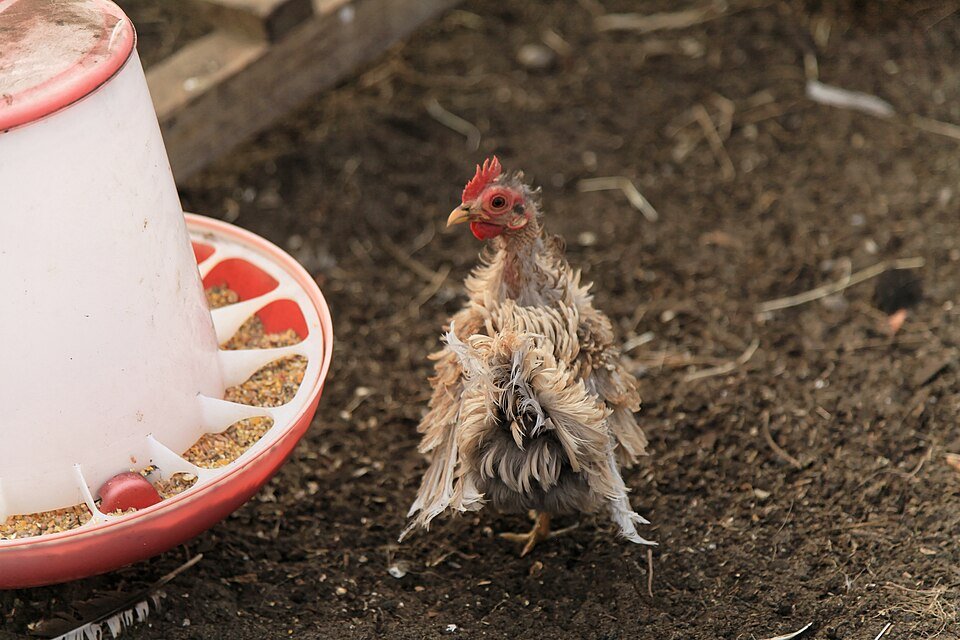
Cover photograph by Frank Vincentz, CC BY-SA 3.0, via Wikimedia Commons.
