For a backyard flock that already drinks from an open rim, the Farm-Tuff 3-gallon fountain is a simple starting point. The 3-gallon Omlet suits a run where bedding keeps landing in the water because you can start with cups and switch to nipples. If you have a hose at the coop and room for a larger unit, choose the Harris Farms for a top-fill tray or the OverEZ for a flock that already uses nipples. Compare how the birds reach the water and how you’ll clean it before deciding how many gallons to buy.
We may earn a commission when you buy through links on this page.
Our picks at a glance
Start with the features that fit your setup.
Best for switching between cups and nipples
Omlet Insulated Stay Clean 3-Gallon Waterer

Start with cups and switch to nipples if bedding keeps ending up in the drinking water.
- Capacity
- 3 gal
- Drinking point
- Interchangeable cups or nipples
Best compact open-tray option in this comparison
Farm-Tuff 3-Gallon Galvanized Fountain

A familiar tray and small reservoir for a flock that already drinks from an open fountain.
- Capacity
- 3 gal
- Drinking point
- Open circular tray
Also in this guide
- Harris Farms Easy-Fill 6.25-Gallon DrinkerBest for a bucket-style top fill
- Premier 1 Optimus Poultry WatererBest for a removable elevated tray
- Little Giant 8-Gallon Plastic Dome WatererBest for seeing the level in a larger gravity tank
- OverEZ Classic 12-Gallon WatererBest for a stationary high-capacity nipple station
Chicken waterers compared
| Product | Capacity | Drinking point | Fill and placement | Water weight when full |
|---|---|---|---|---|
| Omlet Insulated Stay Clean 3-Gallon Waterer | 3 gal | Interchangeable cups or nipples | Top lid, stand included | 25 lb |
| Farm-Tuff 3-Gallon Galvanized Fountain | 3 gal | Open circular tray | Lift outer cover, floor-standing | 25 lb |
| Harris Farms Easy-Fill 6.25-Gallon Drinker | 6.25 gal | Open circular tray with float | Top lid, floor placement | 52 lb |
| Premier 1 Optimus Poultry Waterer | Approx. 6.6 gal | Open removable tray | Top lid with shutoff valve | 55 lb |
| Little Giant 8-Gallon Plastic Dome Waterer | 8 gal | Open raised tray | Top fill, three legs | 67 lb |
| OverEZ Classic 12-Gallon Waterer | 12 gal | 3 front nipples | Top lid, floor placement | 100 lb |
Six chicken waterers
01 / Best for switching between cups and nipples
Omlet Insulated Stay Clean 3-Gallon Waterer
Best for: An adult flock where you want a covered tank and the option to change how the birds drink.
- Capacity
- 3 gal
- Drinking point
- Interchangeable cups or nipples
Why consider it
- Cup and nipple sets supplied
- Stand keeps the outlets above a flat floor
- Viewing strip helps show when the tank needs refilling
Keep in mind
- Cup openings still collect debris
- Nipples call for a transition check
- Insulated tank has no built-in heat
Read the full analysis of Omlet Insulated Stay Clean 3-Gallon Waterer
The 3-gallon model comes with a stand and sets of cups and nipples. Omlet lists six of each in the box, including one spare of each. The Omlet support guide also explains how to set the drinking height. Check reach with your smallest hen before changing your setup. The standing unit has a fixed height with its included legs, and Omlet offers a separate hanger for a supported installation.
The enclosed, insulated tank suits a keeper who wants a single model to try both drinking styles. Start with the cups if your flock already drinks from a tray. If you change to nipples, keep the familiar drinker available while you observe each bird using the new one. Clear the cups during checks and make sure each nipple delivers water. Allow clearance around the legs and fittings so they are easy to inspect.
This is an unheated waterer. Confirm that water comes out of the selected fittings during a freeze and keep an alternative ready if they ice up. The buying link identifies the 3-gallon model. Confirm the finish with the seller if color matters.
Key specs: 3-gallon insulated reservoir, top lid, water-level window, legs, six cups and six nipples including spares, according to Omlet.
02 / Best compact open-tray option in this comparison
Farm-Tuff 3-Gallon Galvanized Fountain
Best for: A keeper with a level platform who wants a gravity fountain with a metal body and a familiar drinking rim.
- Capacity
- 3 gal
- Drinking point
- Open circular tray
Why consider it
- Three-gallon size keeps the water load below the larger models here
- Visible water around the rim
- Double-wall metal body and cone-shaped top
Keep in mind
- Open rim collects bedding if placed near scratching
- Outer shell has to be lifted for access
- Flat support required and not designed to hang
Read the full analysis of Farm-Tuff 3-Gallon Galvanized Fountain
Millside’s model 3G uses a double-wall galvanized body and a vacuum feed to maintain water in the shallow rim. Birds can approach the rim from around the unit if the location is clear. The linked listing calls it a floor-standing fountain. The top handle is useful for handling the cover or empty fountain during cleaning. Set the assembled unit on a flat, solid support.
The shell lifts for filling rather than opening a fill cap on top. Plan a spot where you can set the shell down while you deal with the reservoir. An open rim is easy to inspect, and you will see when it needs a rinse after hens have scratched nearby. Check that the outer shell sits correctly after cleaning and watch the tray refill before you walk away.
Choose this one if a lower-capacity, visible tray fits your routine. If that rim is routinely full of litter, a covered tank with nipples puts less water on display at the drinking point.
Key specs: Model 3G, 3 US gal, double-wall galvanized steel, cone top, open vacuum-fed rim on a level support.

03 / Best for a bucket-style top fill
Harris Farms Easy-Fill 6.25-Gallon Drinker
Best for: A flock that already uses a tray and a keeper who can refill the waterer in place.
- Capacity
- 6.25 gal
- Drinking point
- Open circular tray with float
Why consider it
- Top-fill lid on the exact 6.25-gallon version
- Float feeds the visible drinking rim
- Tray access around the bucket where space allows
Keep in mind
- Full reservoir is heavy to move
- Exposed rim catches debris
- Base and moving float need inspection after cleaning
Read the full analysis of Harris Farms Easy-Fill 6.25-Gallon Drinker
The linked Large Flock Easy-Fill is the 6.25-gallon bucket with a green lid and tray. The exact model 1000267 has a float in the base that meters reservoir water into the rim. Open the lid to refill from above. Leave room for the lid and a hose or jug, especially if you are putting the bucket under a low shelf.
The water alone weighs about 52 pounds when full. Put the empty drinker where you want it, then fill and clean it where you can manage the weight and drain the water. A bucket handle can be convenient for moving the empty unit. For a full tank, choose a stable flat spot rather than planning around carrying or suspending it.
You can see the water at the rim and the birds can drink from different sides. The same exposed rim needs regular cleaning. If the tray stays low or overflows after reassembly, check the float and base connection according to the instructions for the version you receive.
Key specs: Large Flock Easy-Fill, model 1000267 / 4234, 6.25 US gal, plastic tank, top lid and float-fed tray.

04 / Best for a removable elevated tray
Premier 1 Optimus Poultry Waterer
Best for: A keeper who refills in place and wants to rinse the drinking tray without taking the entire tank apart.
- Capacity
- Approx. 6.6 gal
- Drinking point
- Open removable tray
Why consider it
- Shutoff lets you remove the tray for cleaning
- Two-piece tank gives access inside
- Manufacturer publishes assembly instructions and replacement parts
Keep in mind
- Valve and lid need to be set correctly during refills
- Fixed stand height must suit the flock
- Water alone weighs about 55 pounds when full
Read the full analysis of Premier 1 Optimus Poultry Waterer
Premier names it the 6-gallon model. The OLBA manual specifies 25 liters, about 6.6 US gallons. Its stand raises the drinking tray, and the two-piece tank opens for cleaning. The small shutoff valve lets you stop the flow before removing the tray. Check that your birds can reach the rim comfortably on the supplied stand.
Premier’s instructions say to close the valve before filling, tighten the lid, then reopen the valve. This is a vacuum-fed design. If air gets in where the tank should seal, water can continue draining. The quick check is to watch the tray reach its normal level and stop filling after you set it up.
This is useful where dirty trays are the main frustration and you can reach the shutoff easily. The tray still needs to be emptied and washed, and the tank needs its own cleaning. Premier lists an extra tray for its version. Check the linked offer’s box contents if the spare matters to your routine.
Key specs: Model 536000, 25 L (about 6.6 US gal) per OLBA, top-fill, free-standing, removable open tray and brass shutoff.

05 / Best for seeing the level in a larger gravity tank
Little Giant 8-Gallon Plastic Dome Waterer
Best for: A keeper with room for a freestanding gravity waterer who wants to read the level from outside the run.
- Capacity
- 8 gal
- Drinking point
- Open raised tray
Why consider it
- Translucent reservoir makes it easy to check the level
- Top-fill design
- Legs keep the tray off the ground
Keep in mind
- Elevated tray may be high for the smallest birds
- Open tray needs regular checks and cleaning
- Eight gallons of water makes the unit heavy to move
Read the full analysis of Little Giant 8-Gallon Plastic Dome Waterer
Look for DOMEWTR8 when buying. Miller Manufacturing lists several capacities with a similar shape. The linked one holds 8 gallons, uses a top fill, and has three legs under its gravity-fed tray. The translucent body makes the waterline visible without opening the top.
Set the legs on a level surface and check the smallest bird at the tray. Leave space above for filling and around the base for birds and cleaning. An 8-gallon load is about 67 pounds of water. Refill it where it stands and decide in advance where you can empty it for a wash.
Pick it over a smaller bucket if the level is easy to read from your usual route and you can handle the footprint. If you repeatedly find litter in the drinker, the legs may help keep it above some scratching, but debris can still fall into the open tray.
Key specs: DOMEWTR8, 8 US gal, translucent plastic tank, top fill, freestanding three-leg base and open drinking tray.

06 / Best for a stationary high-capacity nipple station
OverEZ Classic 12-Gallon Waterer
Best for: A nipple-trained adult flock with space for a stationary reservoir and a way to refill and drain it on site.
- Capacity
- 12 gal
- Drinking point
- 3 front nipples
Why consider it
- Largest tank in this comparison
- Covered water stored behind three small outlets
- Manufacturer sells replacement nipples
Keep in mind
- Front-only drinking access needs space
- Heavy when full and best filled where it sits
- Nipples require a flow check and a supervised transition
Read the full analysis of OverEZ Classic 12-Gallon Waterer
The OverEZ Classic combines a 12-gallon tank with three nipples across the front. Keep that whole face accessible. If other hens cluster there or one bird guards the front, add a second accessible water station even when the tank holds plenty. The number of drinking points is the same whether the tank is partly filled or full.
Water alone weighs about 100 pounds at the stated capacity. Put it in position empty, then fill at the coop. Plan for cleaning and for draining any remaining water. Keep the familiar waterer in the run while you confirm each bird knows how to use the new outlets. Check all three for flow and look for wet bedding under them during your normal rounds.
The top opening provides access for filling and the model has a cord access port for compatible equipment. It ships as a waterer, with optional heating equipment separate. Buy it for the larger covered reservoir and straightforward placement if those solve a problem at your coop.
Key specs: OEZCW Classic, 12 US gal, three front nipples, floor placement, top refill opening and cord access port.
How we chose
We checked six complete waterers against the linked listings and manufacturer documentation. We compared the actual reservoir capacity, drinking points, fill method, and the parts you need to reach during cleaning. We kept replacement cup and nipple kits out of the picks because they need a separate reservoir. This guide covers unheated waterers for adult chickens and compares documented features and fit.
Threads about debris in cups and switching to nipples helped frame two practical checks. Look at how much water is exposed at the outlet, and watch your own hens drink before removing their old setup. Individual experiences cannot predict whether a specific unit will leak or how fast your flock will adapt.
How to choose a chicken waterer
Start with the drinking point
An open tray offers plainly visible water along its rim. It’s convenient when the flock already uses a fountain and you have a clear spot above the worst of the kicked litter. A float or vacuum can refill the rim from inside the tank. The tray itself still needs inspection and washing. Place it where you can reach it without stepping over the feeder or blocking the birds’ approach.
Individual cups give hens a smaller area of visible water. Each cup needs room for the bird to approach and for you to rinse the fitting. Horizontal nipples release water when pecked, so less standing water is exposed to debris at the drinking point. The trade-off is that you need to check flow and confirm the birds use them. A wet patch under one nipple can mean drips while birds drink or a fitting that continues leaking after they leave. Watch it with the birds clear before deciding what needs attention.
Size the reservoir and the access separately
First note how much water you add to bring your current setup back to the same fill line over several days. Do this during your usual morning check. If one representative day took 12 cups, that is three quarters of a US gallon removed from the reservoir. A 3-gallon unit would give room above that amount for the same routine. A day with spillage or a leak can skew the number, and a hot spell can raise demand. Plan to check sooner when conditions change. University of Minnesota Extension recommends continual access to clean, fresh water and changing it daily.
Next look at the number and location of usable drinking spots. Three nipples along one face give you three points to check and one side for the birds to approach. An open rim can be reached from different sides if the waterer is clear of the wall. If several birds are waiting at the same place, or if one bird keeps other hens away, give them a second water station in a different spot. Two separate units can also give you a backup while you clean or fix one.
Work backward from how you’ll carry and wash it
A US gallon of water weighs about 8.34 pounds. At their nominal capacities, the water alone in the 3-gallon fountain weighs about 25 pounds, the 6.25-gallon Harris Farms about 52, and the 12-gallon OverEZ about 100. The container adds its own weight. If your only tap is across the yard, measure what you can comfortably carry in a smaller jug. You can fill a larger tank with several trips, or use two smaller stations that are easier to bring back to the wash area.
For in-place refilling, check whether you can open the lid fully with the coop roof or gate in its normal position. Then work out how you’ll empty the reservoir without soaking the bedding. A removable tray is especially useful if you find yourself washing the rim more often than you need to disassemble the tank. Look for a shutoff if you want to lift that tray without draining all the water first.
Think about the weather at the actual spot
A shaded, accessible spot makes it easier to inspect and refresh water on hot days. Check more often when it is hot and verify that the drinking points are working. Penn State Extension’s summer flock guidance emphasizes fresh, cool water during warm weather. During freezing weather, check both the reservoir and the outlet. A tank can still hold liquid while a small cup or nipple is iced over. Use a separate winter watering plan where freezing is routine.
Set up and check the waterer
Place it before filling
Set the waterer on a flat, stable surface using its stand or the support permitted by the maker. Check that the lowest-ranking birds can approach it without squeezing past the feeder and that the smallest hen can reach the water. For the Omlet, the maker gives different height guidance for cups and nipples, and a hanging setup calls for the appropriate hardware and a support that can carry the filled load. Follow the manual for the exact version.
Verify the outlet on the first fill
If the unit has a shutoff, follow the maker’s sequence for the lid and valve before you fill. With a tray, watch the water rise and settle below the rim. With nipples, actuate each one and watch for water to stop when you release it. If the tray keeps filling or the tank level falls without the birds using it, check the seal, seating, or float as appropriate for the design. Keep another water source available while you troubleshoot.
Keep the old waterer available when introducing cups or nipples. Watch the birds use the new fittings at more than one check and pay attention to the birds that hang back. Remove the old unit only after you’ve confirmed the flock is drinking from the new one. This matters most when the new interface uses a peck to release water. A reservoir can look full because its outlets are hard to reach or because the hens are still unfamiliar with them.
Make cleaning part of the refill
Empty dirty water away from the litter, wash the tray or cups, and refill with fresh water. Follow the maker’s cleaning instructions for seals, float parts and nipples. Look inside the tank and around the waterline for residue. Before leaving the run, check the actual water at the rim or confirm flow at the nipples, even when the tank shows plenty of water. The tank level tells you what’s stored. The outlet tells you what the birds can drink.
FAQ
Is a chicken waterer with nipples better than a tray?
Nipples suit a flock that uses them reliably and a run where litter keeps getting into open water. A tray is a useful choice when the flock already drinks from one and you can reach it for frequent cleaning. Cups are another option if you want a covered reservoir and a visible drinking point.
How big a waterer do I need for six hens?
Start by tracking what you refill on typical days and checking access at the drinking points. A 3-gallon model can be a reasonable choice for a small adult flock when you can refresh the water daily and confirm the hens can all drink. Heat, spillage and access can change what you need.
How often should I change the water?
Provide fresh water daily and replace it sooner if it becomes dirty. Check the tank and the drinking points during your rounds. A large covered reservoir still needs regular inspection and cleaning.
Why is my gravity waterer overflowing?
Start with a level surface and check how the lid, shell, or base seats. On a vacuum-fed design, an air leak can let water continue to drain. On a float-fed design, inspect the float and base connection according to the model’s instructions. Keep a working second waterer out while resolving the problem.
Can I hang a top-fill chicken waterer?
Check the manual. A handle may be provided for lifting or removing a cover. Hanging a filled waterer requires a version intended for hanging, the supported hardware, and a mounting point rated to carry it.
Will an insulated waterer keep water from freezing?
Insulation slows heat loss. An unheated tank and its outlets can still freeze, so check that water actually reaches the birds. Use a winter setup suited to your temperature if freezing is routine. University of Minnesota Extension’s cold-weather guide covers keeping water available in winter.
Which waterer should you buy?
Choose the Farm-Tuff if you want a 3-gallon open tray and can reach it easily for cleaning. Choose the Omlet if you want the option to switch from cups to nipples on the same tank. For a bigger refill in place, pick the Harris Farms if your birds already use an open rim, or the OverEZ if they reliably use nipples and you have space to clean and drain it.
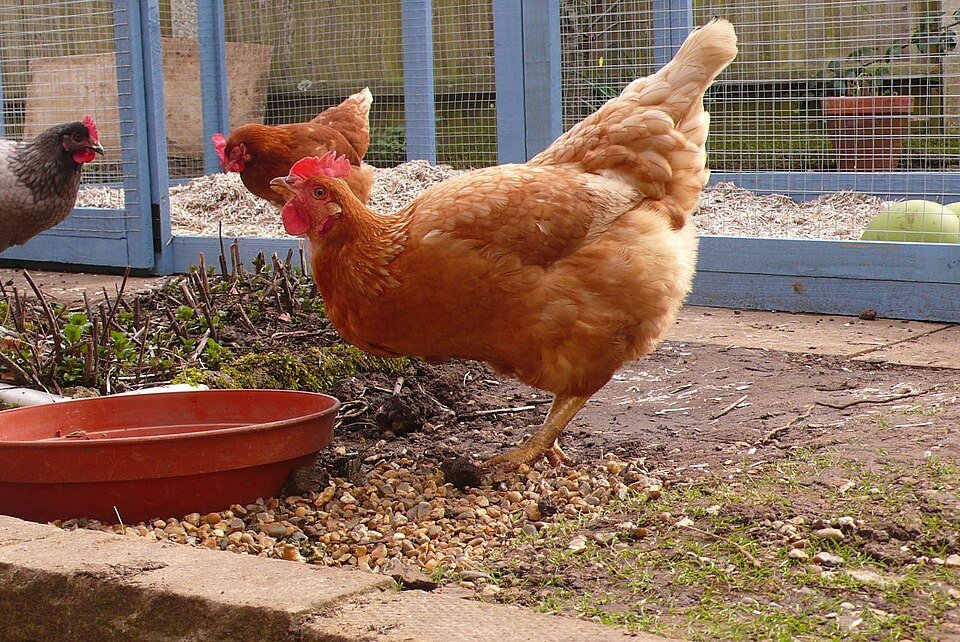
Cover photograph by Smoobs, CC BY 2.0, via Wikimedia Commons.
