For a chicken coop with a properly specified framed cavity, start by comparing the labeled EcoTouch R-13 roll with Johns Manville K-1262 R-15 wall batts; choose by the required thickness, facing and cutting layout. The deeper K-1244 batt and the two reflective rolls serve different assembly requirements. There is no universal winner for every coop: decide the building detail, protect the insulation from birds and confirm the delivered package before installing it.
We may earn a commission when you buy through links on this page.
Our picks at a glance
Start with the features that fit your setup.
Roll format for an appropriately designed cavity
Owens Corning EcoTouch R-13 Kraft-Faced Roll

A nominal 3½-inch-thick roll for a specified framed assembly; verify the selected three-roll offer.
- Thermal basis
- Labeled R-13 at stated thickness
- Material and facing
- 3½ in.; kraft-faced fiberglass
Bubble-core material for a documented reflective assembly
Reflectix BP24025 Double-Reflective Roll

A 24-inch-by-25-foot roll named in the maker’s storage-building instructions; the assembly determines thermal performance.
- Thermal basis
- No universal material R-value used
- Material and facing
- Reflective / bubble / bubble / reflective
Also in this guide
- Johns Manville K-1262 R-15 Kraft-Faced BattsPre-cut wall batts in a large bundle
- Johns Manville K-1244 R-38 Kraft-Faced BattsDeep-cavity option with a large thickness requirement
- SmartSHIELD 5 mm Foil/Foil Foam-Core RollFoam-core alternative within a specified reflective assembly
Compare the five insulation formats
| Product | Thermal basis | Material and facing | Nominal dimensions | Important distinction |
|---|---|---|---|---|
| Owens Corning EcoTouch R-13 Kraft-Faced Roll | Labeled R-13 at stated thickness | 3½ in.; kraft-faced fiberglass | 15 in. × 32 ft per roll | Listing offers three; photo shows one |
| Johns Manville K-1262 R-15 Kraft-Faced Batts | Maker R-15 at 3½ in. | Kraft-faced fiberglass batts | 15 × 93 in.; seven per bag | 15 bags; confirm bundle quantity |
| Johns Manville K-1244 R-38 Kraft-Faced Batts | R-38; table 12½ in., photo 13 in. | Kraft-faced fiberglass; K-1244 | 16 × 48 in.; eight per bag | Nominal 42.66 sq ft per bag |
| Reflectix BP24025 Double-Reflective Roll | No universal material R-value used | Reflective / bubble / bubble / reflective | 24 in. × 25 ft; BP24025 | Specified air spaces and layers matter |
| SmartSHIELD 5 mm Foil/Foil Foam-Core Roll | No R-17 material equivalence assumed | 5 mm closed-cell polyethylene; foil faces | Selected roll: 24 in. × 50 ft | Maker lists exact size in 5 mm family |
Five offers for specified building assemblies
01 / Roll format for an appropriately designed cavity
Owens Corning EcoTouch R-13 Kraft-Faced Roll
Best for: A project whose specified cavity, facing and thermal target call for this exact roll format.
- Thermal basis
- Labeled R-13 at stated thickness
- Material and facing
- 3½ in.; kraft-faced fiberglass
Why consider it
- Package label identifies size, thickness and R-value
- Roll format differs from the pre-cut batt options
- EcoTouch family documentation states facing limitations
Keep in mind
- Retail brand and material fields conflict with the pictured package
- Photo shows one roll, not the selected three-roll quantity
- Requires the appropriate concealed assembly and finish
Read the full analysis of Owens Corning EcoTouch R-13 Kraft-Faced Roll
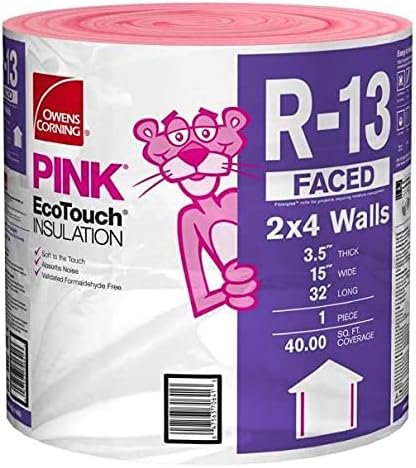
Start with this roll when the assembly specification calls for kraft-faced fiberglass of its stated thickness and width. The pictured EcoTouch label identifies R-13, a 3½-inch thickness, 15-inch width and 32-foot length. The roll format gives a different cutting layout from pre-cut batts; it does not establish a better thermal result.
The selected listing offers three rolls, while its main photograph shows a single package marked 40 square feet. Treat the quantity as a retail package claim to confirm. Another field calls the brand Vigpil and the material plastic, conflicting with the Owens Corning fiberglass package. We use the visible product label and manufacturer family documentation for the material, not those fields.
Do not leave the facing accessible as a finished coop wall. Owens Corning’s EcoTouch data sheet says kraft facings can burn and cannot remain exposed. The chosen finish, installation and vapor-retarder arrangement must suit the actual building. This guide has not verified the delivered batch or measured its installed performance.
Key specs: Pictured EcoTouch kraft-faced fiberglass: R-13; 3½ in. thick; 15 in. × 32 ft; 40 sq ft per roll. ASIN B093W33KSZ offers three rolls; verify delivered labels and quantity.
02 / Pre-cut wall batts in a large bundle
Johns Manville K-1262 R-15 Kraft-Faced Batts
Best for: A specified wall-cavity project that can use the documented batt size and the unusually large retail bundle.
- Thermal basis
- Maker R-15 at 3½ in.
- Material and facing
- Kraft-faced fiberglass batts
Why consider it
- K-1262 identity supported by package and maker table
- Piece dimensions and per-bag count documented
- Pre-cut length suits a different layout from a roll
Keep in mind
- Fifteen-bag offer may be excessive for a small project
- Retail coverage figures differ
- Facing and installed fit require an appropriate finished assembly
Read the full analysis of Johns Manville K-1262 R-15 Kraft-Faced Batts
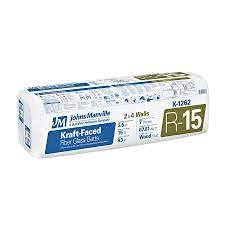
These batts are the pre-cut wall-format choice when a project calls for the K-1262 specification and can use the selected bundle quantity. Johns Manville’s table identifies R-15, 3½-inch thickness, 15-by-93-inch pieces and seven pieces per bag. The pictured package shows K-1262 and the same wall-oriented format.
The Amazon offer is a fifteen-bag bundle, which may be far more material than a small coop needs. Its title rounds the coverage to 1,017 square feet; the description gives 1,014.15. The maker lists 67.81 square feet per bag, which gives 1,017.15 for fifteen bags at that precision, before cuts or other installation requirements. Confirm bag count, labels and order quantity rather than treating either figure as installed coverage.
Choose this over a roll for the specified pre-cut length and layout, not merely because R-15 is larger than R-13. Both facing and thickness remain assembly decisions. The kraft facing needs the appropriate covering, and the whole installation must remain beyond the birds’ access. We have not checked a delivered bundle or compared its waste against a roll.
Key specs: JM K1262/K-1262; R-15; kraft-faced fiberglass; 3½ in. thick; 15 × 93 in.; seven pieces and nominal 67.81 sq ft per bag. ASIN B097Z1JH3G offers fifteen bags.

03 / Deep-cavity option with a large thickness requirement
Johns Manville K-1244 R-38 Kraft-Faced Batts
Best for: A separately designed deep cavity whose specification actually calls for this K-1244 batt.
- Thermal basis
- R-38; table 12½ in., photo 13 in.
- Material and facing
- Kraft-faced fiberglass; K-1244
Why consider it
- Package code resolves the documented K1244 identity
- Maker states thickness, piece count and size
- A deep-batt format distinct from the wall products
Keep in mind
- Pictured 13-inch thickness conflicts with the current 12½-inch table
- Kraft/FSK title conflict requires checking the delivered label
- Higher labeled R-value does not make it a universal coop upgrade
Read the full analysis of Johns Manville K-1244 R-38 Kraft-Faced Batts
K-1244 is the deep-batt option in this comparison. The maker table identifies R-38 at 12½ inches thick, with eight 16-by-48-inch pieces and nominal coverage of 42.66 square feet per bag. The photographed package shows K-1244, R-38 and kraft-faced fiberglass. The photograph also says 13 inches thick, differing from the current table’s 12½ inches. Confirm the actual package thickness and applicable lot documentation; we do not assume this is rounding or a generation change.
The title combines “Kraft/FSK,” but the package photograph and Johns Manville’s K1244 table identify kraft facing. We therefore treat this as the kraft-faced product and require confirmation of the delivered label before installation. The manufacturer distinguishes standard kraft from FSK-25; they do not have interchangeable exposed-use instructions.
Its thickness is the main reason to consider or reject it. It is not a direct replacement for a 3½-inch wall batt simply because the R-number is higher. Do not assume compression into a shallow cavity preserves the labeled thermal result. Use it only where the actual assembly design, cavity depth, facing and finish support this specification.
Key specs: JM K1244/K-1244; R-38; kraft-faced; current table: 12½ in. thick, 16 × 48 in., eight pieces, nominal 42.66 sq ft per bag. Photo says 13 in. thick; resolve delivered lot specification. ASIN B0HMMB567D.
04 / Bubble-core material for a documented reflective assembly
Reflectix BP24025 Double-Reflective Roll
Best for: A project designed around the exact reflective assembly rather than a direct substitution for fiberglass batts.
- Thermal basis
- No universal material R-value used
- Material and facing
- Reflective / bubble / bubble / reflective
Why consider it
- Exact BP24025 appears in a maker application sheet
- Roll dimensions and bubble-core format are documented
- Assembly instructions make the performance conditions explicit
Keep in mind
- No single assembly R-value applies to every installation
- Requires application-specific spaces and other layers
- Not a direct thermal substitute for a batt of the same area
Read the full analysis of Reflectix BP24025 Double-Reflective Roll
BP24025 is the bubble-core option when the building design calls for a documented reflective assembly. Reflectix names this exact 24-inch-by-25-foot roll in its storage-building installation sheet. That product-to-document match matters more than a generic silver appearance or a broad insulation label.
The sheet describes different wall arrangements with specified air spaces and other layers. Their R-values apply to those arrangements, not to every use of the bare roll. We do not place one of those numbers beside the fiberglass material ratings as though they measured the same thing. Rolling it flat against a wall does not reproduce the documented assembly.
Use the manufacturer’s installation sheet to establish the selected application, then confirm that the complete design suits the coop and protects the material from birds and routine wear. This guide does not prescribe a layer sequence or moisture-control detail. Nominal roll area is raw material area, not a statement of useful installed coverage.
Key specs: Reflectix BP24025; 24 in. × 25 ft; reflective/bubble/bubble/reflective roll. Maker storage-building sheet dated February 2025; thermal results depend on the specified assembly.

05 / Foam-core alternative within a specified reflective assembly
SmartSHIELD 5 mm Foil/Foil Foam-Core Roll
Best for: A design that specifically calls for this foil-faced foam-core product and its documented installation conditions.
- Thermal basis
- No R-17 material equivalence assumed
- Material and facing
- 5 mm closed-cell polyethylene; foil faces
Why consider it
- Maker identifies the core material and nominal thickness
- Foil/foil family includes the selected roll dimensions
- Different core format from the bubble-layer option
Keep in mind
- Retail R-17 label is not a universal material comparison
- No blanket moisture or exposed-use suitability established
- Requires the intended assembly and finish to be specified
Read the full analysis of SmartSHIELD 5 mm Foil/Foil Foam-Core Roll
SmartSHIELD supplies the foam-core reflective format in this selection. The manufacturer describes a 5-millimeter closed-cell polyethylene core with foil on both sides and lists the selected 24-inch-by-50-foot size. That construction differs from Reflectix’s bubble layers, although both require a defined assembly before their thermal claims can be compared.
The Amazon title advertises R-17. The maker’s technical section reports thermal resistance by heat-flow direction and identified test arrangements, rather than establishing a universal number for any coop wall. We do not treat the title’s R-17 as equivalent to the material rating on a fiberglass package, or as evidence that a thin roll outperforms the thicker batts.
Compare this with the bubble roll for the specified core, dimensions and available installation documentation. Obtain the complete detail for the intended location and finish before ordering. We have not tested heat transfer, pecking resistance, moisture behavior or fire performance, and do not adopt the listing’s broad claims about safety, condensation prevention or energy savings.
Key specs: SmartSHIELD EN5 family; selected ASIN B08JS72W4Q; 5 mm closed-cell polyethylene core with two foil faces; selected nominal roll 24 in. × 50 ft; assembly-dependent thermal claims.
How we chose
We compared five current U.S. Amazon offers using their exact listings, main package images and manufacturer documentation. The new package inspection establishes the JM K-1262 and K-1244 codes and identifies the EcoTouch roll. Reflectix names BP24025 in its storage-building sheet, while Insulation Marketplace lists the selected size in its SmartSHIELD 5 mm foil/foil family. We have not installed or tested these materials in a coop.
The comparison separates three fiberglass packages from bubble-core and foam-core reflective rolls. The two JM packages have substantially different thicknesses and intended cavity formats; they are not simply different bag counts. A roll area, a labeled R-value and a whole-assembly thermal result answer different questions, so there is no misleading single-number performance ranking.
We excluded acoustic-only and mechanical-insulation listings whose exact building application was not established, craft foam and the retail-described R-15 unfaced offer whose maker identity remained unclear. Retail conflicts are stated beside the selected products. Package photographs help identify an offer but cannot prove what a seller will deliver, the finished assembly’s performance or suitability for a particular flock.
Buying guide: specify the whole assembly
Establish the building problem first
Write down the climate, existing wall or roof construction, cavity dimensions, moisture conditions and planned interior finish. Repairing rain entry, managing ventilation and adding thermal insulation are separate decisions. A new insulation layer should not conceal an unresolved leak or block a necessary air route.
University of Minnesota Extension’s cold-weather guidance says to close insulation off so chickens cannot peck or scratch it, and discusses ventilation as part of moisture management. Use that guidance to plan a protected interior boundary. It does not certify any of these Amazon packages or supply a universal thermal target for every coop.
Match the facing and finish
Kraft-faced fiberglass is not a finished interior wall. Johns Manville’s fiberglass data sheet says standard kraft and foil facings can burn and must be covered by the appropriate finish. It distinguishes those facings from FSK-25. Do not interpret a mixed retail title as permission to use kraft in an exposed application.
Facing direction, vapor-retarder needs and the interior finish depend on the actual design and applicable requirements. Obtain the appropriate assembly and installation instructions. This guide supplies no universal vapor-barrier position, wall-layer recipe or claim that one finish satisfies every location.
Compare the thermal basis before the number
The fiberglass values in the table are the maker’s labeled ratings at the stated thickness. The reflective rolls need their own assembly conditions; their retail R-number is not automatically the same kind of measurement. Confirm the product, thickness, heat-flow direction and complete tested arrangement before comparing results.
The Reflectix storage-building sheet names BP24025 and specifies air spaces and other layers for different applications. That is why a silver roll placed against any convenient surface does not automatically reproduce one of the sheet’s thermal results. Follow the actual selected application instead of borrowing a favorable figure from another arrangement.
Separate purchase area from installed coverage
List the pieces or rolls in the actual order, their nominal dimensions and the finished areas in the project. Cutting, obstacles and the specified installation detail affect material requirements. Do not assume a roll’s printed area is the amount of completed wall you will obtain.
The fifteen-bag JM bundle deserves particular attention for a small coop. Its quantity can dominate the buying decision even if the individual batt is the specified product. Confirm the package before ordering and compare the actual project requirement with the amount supplied. We have not established the seller’s current return terms or calculated a universal waste allowance.
A practical comparison before ordering
Suppose the project specification calls for 15-inch-wide material in a 3½-inch cavity. The EcoTouch roll and K-1262 batts are relevant formats to investigate, provided the facing and thermal specification also match. The roll gives a nominal 32-foot length to plan cuts from; the JM wall batts have a nominal 93-inch length. Choose from the real cutting layout and order quantity, rather than declaring the higher R-number the winner.
The deep K-1244 batt, whose pictured and table thicknesses also need reconciling, does not become appropriate for that shallow cavity because its label says R-38. The reflective rolls also do not become substitutes merely because their titles carry large R-numbers. If the specified detail changes to a reflective assembly, compare its required core, air spaces, adjoining layers and finish as a complete arrangement.
Before installation, compare the delivered label with the order record: manufacturer, line, model, facing, size, thickness and quantity. Stop and resolve a mismatch with the supplier or manufacturer. A familiar-looking package is useful identification evidence, but it is not a reason to ignore a conflicting delivered label.
FAQ
What is the best insulation for every chicken coop?
There is no single product that fits every building. Choose for the actual cavity, climate, moisture and ventilation plan, facing and protected interior finish. The materials here are candidates for specified assemblies, not ready-to-expose coop wall coverings.
Is the highest R-value automatically the best choice?
No. The value must apply to the product at the intended thickness or to the complete documented assembly. A deep batt cannot be assumed to retain its labeled performance when squeezed into a shallow cavity, and a reflective assembly number is not directly interchangeable with a fiberglass material rating.
Can chickens reach the insulation?
Plan the finished boundary to keep it inaccessible to pecking and scratching. University of Minnesota Extension explicitly calls for closing it off. The material choice does not replace the design, installation and inspection of that protective boundary.
Does the selected K-1244 package have kraft or FSK facing?
The maker’s K1244 table and the photographed package identify kraft facing. The Amazon title mixes Kraft/FSK, so confirm the delivered label. Do not transfer the manufacturer’s separate FSK-25 exposed-use guidance to the kraft package.
Can I glue a reflective roll flat to a wall and use its advertised R-number?
Do not assume that arrangement reproduces the quoted performance. Reflective-product results depend on the stated application, air spaces, adjoining layers and heat-flow conditions. Obtain the exact installation detail rather than treating an advertised number as a universal material rating.
Choose the documented assembly first
For a specified framed cavity, compare the EcoTouch roll and K-1262 wall batts for dimensions, facing and order quantity. Consider K-1244 only for an appropriately designed deep cavity, and the Reflectix or SmartSHIELD rolls only within their specified reflective arrangements. Verify the delivered product and protect the finished boundary before birds can reach the material.
Featured product image from the exact Owens Corning package via Amazon listing. It depicts one selected package, not a test or certification by this site.