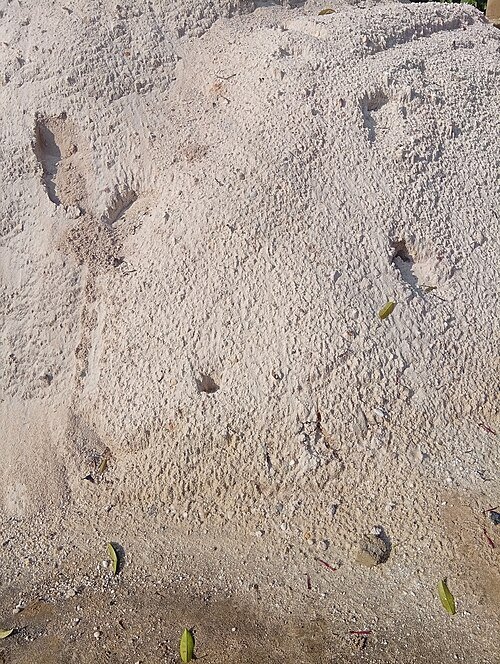
Do not choose chicken-coop sand by the words “construction sand” alone. If you are considering sand, ask for the material’s composition, grading, washing information and safety sheet, then confirm its suitability for your flock with a local poultry extension educator. A bag labeled for masonry or paving is not automatically approved poultry bedding.
We may earn a commission when you buy through links on this page.
Before choosing sand
- IDENTIFYExact material
- CHECKFloor + handling
- PLANCare + removal
The useful question is not simply which bag contains the biggest grains. It is whether a documented material and the way you intend to manage it fit the birds, the floor and the conditions in your coop. This guide is about evaluating bedding for an adult flock, not selecting a brooder surface for newly hatched chicks.
What the poultry research actually supports
Poultry Extension’s litter-material guide reports successful use of sand in commercial broiler studies. That establishes that sand can work in a managed poultry setting. It does not identify every retail sand as interchangeable or prescribe a universal backyard product. A commercial broiler house and a small raised wooden coop are different installations.
The same guide describes desirable litter as uncontaminated, absorbent, reasonably quick to dry, suitable for the birds and practical to obtain and dispose of. It identifies softwood shavings as a common reference material. Those criteria offer a better comparison than a claim that one material is always cleaner, warmer or maintenance-free.
Read the product description without adding claims to it
For example, QUIKRETE describes its All-Purpose Sand as washed, graded coarse sand and lists construction and other uses. The page does not certify it as chicken bedding. That is an example of how to read a manufacturer’s description, not a recommendation to buy that product for a coop.
“Washed” tells you something about processing; it does not mean a material has no fine particles or no handling precautions. Read the product’s sand safety documentation as well as the front of the bag. Follow the current safety sheet for the exact material you purchase, and ask the supplier if the sheet does not clearly identify it.
| Information to check | What it helps establish | What it does not establish |
|---|---|---|
| Composition and additives | What the supplied material contains | Suitability for every bird or coop |
| Grading and washing | How the material is described and processed | A dust-free or maintenance-free surface |
| Current safety sheet | Handling precautions for that exact product | An endorsement as poultry bedding |
| Floor loading and access | Whether the proposed installation is practical | A recommended bedding depth |
Do not infer that play sand, paving sand, masonry sand and a bulk product from a local quarry all have the same composition. Product names can describe intended jobs rather than a single grain specification. If a supplier cannot identify what is in a pile, postpone the purchase instead of relying on a photograph of the texture.
A shortlist of questions to take to the supplier
Ask for the exact product name and current specification. Is it plain sand or a blended material? Does it include a binder or other additive? What grading is supplied, and is it washed? Is there a current safety sheet? Has the supplier changed the source or formulation since the information was written?
Then take that information to a local extension educator with details of your coop. Include whether the floor is ground-level or raised, whether rain enters, whether the material will be indoors or in a run, and whether you are keeping adult hens or chicks. “Can I use sand?” leaves out most of the conditions that affect the answer.
Keep the supplier’s answers with your coop notes. They help you evaluate a second delivery and avoid accidentally replacing an identified material with a different blend. A recommendation for a specific source should not silently become a recommendation for everything sold under a similar name.
Check the building before choosing the bedding
Measure the area you intend to cover and ask the coop manufacturer about the floor’s allowable loading. Do not use an advertised hen capacity as a structural load limit. If you cannot obtain a suitable answer for a raised prefab floor, do not assume it can carry a bulk layer simply because the floor is enclosed.
For estimating the volume of any layer, multiply floor area in square feet by depth in feet. A hypothetical 24-square-foot surface with a 2-inch layer is 24 × 2/12 = 4 cubic feet. This is arithmetic only: it is not a recommended bedding depth or a safe structural load. Weight requires the actual material’s density, and the floor still needs a separate check.
Next, look at how material will enter and leave. Can you reach the corners? Does the door open above the planned floor level? Where will removed material go? Our coop comparison is useful for comparing access arrangements, but a supplier still needs to answer questions about the actual floor.
Plan inspection and removal, not just installation
Whatever bedding you choose, decide how you will recognize and remove soiled or wet material and how you will reach the area beneath the roost. A system that is convenient to fill but awkward to empty is not a complete plan. Do not buy a load before deciding how you will manage the used material.
If water gets into the coop, locate its source instead of treating a bedding change as a building repair. Check the roof, openings and waterer. Ask whether the enclosure provides the access needed to address those problems. Compare the product layouts with the tasks you will actually perform.
Do not describe a sand floor as self-cleaning, germ-free or permanent. The evidence summarized above does not support those claims. Nor should a clean-looking surface be used to diagnose the health of the flock. Questions about sick birds belong with a veterinarian, not with a choice between two bedding bags.
When a different bedding plan is simpler
If the material cannot be identified, the floor load is unknown, or removal would be difficult, pause and compare another bedding system. That is a practical purchasing decision, not proof that sand is unsuitable for every coop. Discuss locally available options against the same criteria: composition, suitability, handling, ongoing care and disposal.
Use the chicken coop buying guide to check the enclosure itself before choosing a floor material around it. The best outcome is a documented bedding plan matched to a coop you can maintain, not a large delivery selected from a generic product label.
Common questions
Is all-purpose sand automatically safe for a coop?
No. A construction-use label does not establish suitability as poultry bedding. Confirm the exact material and discuss the proposed use with local poultry extension.
Does washed sand mean dust-free sand?
No. Read the exact product specification and current safety sheet instead of inferring that washing removes every handling concern.
Can I use the example depth in my coop?
The two-inch layer is only a volume-calculation example. It is not a depth recommendation or evidence that a floor can support the load.
Does this guide recommend sand for baby chicks?
No. This guide evaluates bedding decisions for an adult flock. Get age-appropriate brooding guidance before choosing a chick surface.