Choose horizontal or vertical poultry nipples by the intended mounting, compatible container and supply, and the actual birds’ drinking access. Horizontal side mounting and a vertical under-container arrangement create different layouts; neither is a universal winner for every flock. A 360-degree tip claim does not mean that a complete valve can be mounted at any angle, and a loose nipple kit is a different purchase from a complete drinker with interchangeable attachments.
We may earn a commission when you buy through links on this page.
Compare the arrangement rather than the label
Start with the container’s proposed position and where the drinking point would be. A side-wall outlet needs a compatible wall and room for the bird to approach it. An outlet below a container needs clearance beneath it and a mounting arrangement that follows the exact valve’s instructions.
Those are layout questions before they are brand preferences. Imagine a suitable container on a support whose underside is inaccessible, compared with a suspended container with space below. The same nipple format should not be selected for both merely because its pack is larger or its description says cleaner water.
Our nipple-waterer comparison distinguishes loose DIY parts from complete drinkers. Use it to match the purchase to the project after mapping the drinking point. It does not establish measured leak rates, a learning-time ranking or a health advantage for one orientation.
Choose the format around three concrete checks
Keep the whole valve's orientation separate from its tip
A screw-in body, metal pin, elbow and dribble dish describe different parts of a drinking arrangement. Follow the exact product’s intended orientation. A statement about the pin being activated from different directions does not approve rotating the complete valve into any position that is convenient.
Likewise, a horizontal nipple’s dribble dish is not the same as a separately controlled auto-fill cup. The dish can hold drops near the nipple; it does not make the device the equivalent of a cup maintained at a visible water level. Identify the mechanism you intend to buy before comparing the photographs.
Do not use a similar-looking thread as proof of compatibility. A component designed to screw into a prepared opening may differ from one secured with a separate nut or supplied for an existing drinker. The actual part, container and seal arrangement must be identified together.
Decide between a DIY kit and a complete drinker
RentACoop’s six-pack of horizontal nipples is a component kit. Its exact manufacturer page lists the nipples with dribble dishes and an installation helper; the container and required bit are separate. Buying the kit therefore leaves a container project to specify.
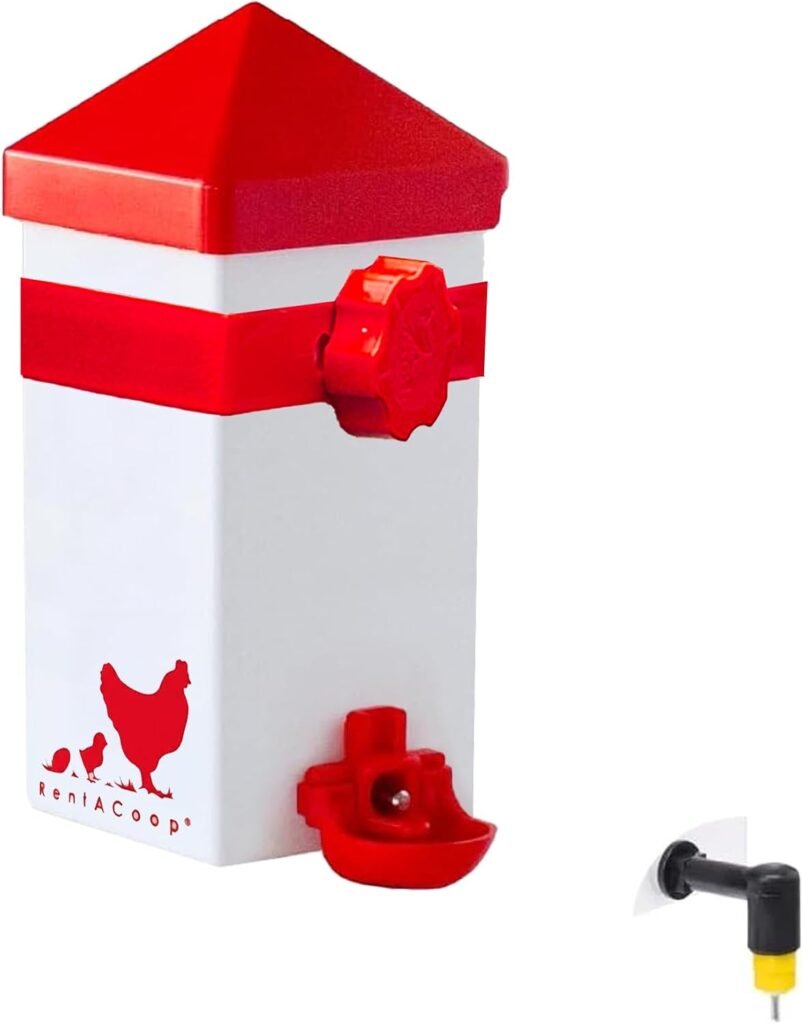
The 32 oz versatile drinker is a complete reservoir supplied with alternative nipple formats. The current manufacturer page identifies a yellow vertical attachment on an elbow and a red horizontal attachment. That lets a buyer compare formats within one documented package without assuming the loose kit contains a reservoir.
The alternatives are not evidence that both attachments should operate at once. Nor does the word automatic mean the small reservoir refills itself from a connected source. Record the intended attachment, mounting and manual-refill task as part of the complete purchase.
Verify supply conditions for the exact component
The RentACoop six-pack page recommends gravity-fed use or a regulated supply at 3 psi or below. That is a condition for that kit, not a pressure setting for every horizontal nipple. It does not automatically apply to a different brand, a vertical component or every complete drinker in the same brand’s range.
Where the exact product’s supply requirement has not been established, obtain the applicable instructions from the manufacturer before connecting it. An adapter that joins the parts does not demonstrate suitable pressure. An open drinking point or a slow-looking drip is not a substitute for knowing the supply conditions.
If the project needs a connected water source, the automatic-waterer comparison separates pressure-fed founts from low-pressure reservoir-fed bells. That broader source decision should be made before trying to convert a nipple choice into a complete plumbing plan. This guide provides no pressure-reducer selection or property-water installation instructions.
Resolve the actual container opening and seals
Do not copy one drilling number across nipples. The RentACoop six-pack page calls for a 9 mm bit, while its linked family manual depicts 3/8 inch. Those are different dimensions, and the applicable instruction for the delivered parts and chosen container needs confirmation.
This example is a reason to stop before making an opening, not a universal instruction to choose either number. The container wall, exact component and seal arrangement still need to match the applicable directions. A different kit may use another attachment method altogether.
Keep unresolved information on the project record. If the fit cannot be established, select another documented arrangement rather than assuming extra sealant, a larger opening or more tightening will make an unknown combination appropriate. This article recommends no universal thread tape, adhesive or chemical sealant.
Use the attachment's actual instructions
The current versatile-drinker manual identifies different use conditions for its red horizontal and versatile attachments. Their interchangeable connection does not make those conditions identical. Match the attachment to the applicable directions and actual birds instead of treating the package as one unrestricted nipple type.
The same manual shows a triangular sliding lid and the Coop Clip with its adjustment knob. Use the opening and attachment diagrams to identify how the supplied parts move and are secured. The useful reference is the documented mechanism, not an assumption made from a photograph of the closed lid.
Keep the instructions for the chosen package and attachment with the care record. Similar capacity or the same brand does not establish that an elbow, clip or replacement valve from another model fits. For an uncertain replacement, use the model information and manufacturer support rather than the nearest-looking photograph.
Observe drinking access without turning it into a training contest
Check that the assembled equipment works under the exact product’s directions, then separately observe the actual birds using it. Water appearing at a tip describes the equipment at that moment. It does not demonstrate that every bird has reached it or learned the required action.
No fixed learning time, universal mounting height or age-based brooding program is prescribed here. A maker’s attachment condition is product information; it is not an independent care assessment of a mixed flock. Resolve the transition within an appropriate care plan and seek help if birds are not drinking.
Do not withhold water to force learning on the basis of this guide. Maintain a working care arrangement while an access or equipment problem is resolved. A purchase that is mechanically convenient but cannot provide observed drinking access is not a finished decision.
Include refilling, cleaning and seasonal use
Look at how the caregiver will reach the reservoir opening, drinking attachment and service parts. A side-mounted unit may fit a support while leaving no room to remove it for cleaning. A suspended arrangement may provide underside clearance but make the source difficult to refill. Include those tasks on the sketch before buying.
The broader chicken-waterer comparison can help if the complete arrangement is still undecided. Compare a manually filled reservoir, drinking mechanism and access together rather than treating a nipple as the only possible solution. No reservoir size establishes an appropriate interval without care checks.
Finally, follow the exact equipment’s seasonal limits. A horizontal format or dribble dish does not by itself establish freeze protection, and this article approves no improvised heater. Choose the arrangement that can be verified and maintained under the actual conditions, with the appropriate attachment and a clear record for the next caregiver.
Common questions
Does a 360-degree nipple tip allow any mounting angle?
No. A tip-activation claim is different from the intended orientation of the complete valve. Follow the exact product's mounting and supply instructions rather than rotating the body based on that phrase or the apparent fit of its threads.
Is a horizontal nipple's dribble dish an auto-fill cup?
No. They are different drinking arrangements. The dish catches drops near a nipple; an auto-fill cup has its own filling mechanism and visible water. Match the exact selected attachment rather than assuming all red cup-shaped parts operate the same way.
Can I use one drill size and pressure setting for every nipple?
No. Match the exact delivered component, container and applicable instructions. Even the selected RentACoop kit has different drill-size language between its page and family manual, which needs confirmation. Another product does not inherit that kit's supply condition or fitting method.
Featured product image from the exact RentACoop via Amazon listing. The drinker photograph shows red horizontal and yellow vertical attachment alternatives for one selected package. It does not establish simultaneous use or actual drinking access. Original format worksheet by Backyard Henhouse.