Choose a chicken-coop latch by the door’s mounting geometry, the caregiver’s access route and how the closure is actually locked. D&D’s one-sided LL3AL and two-sided LokkLatch Plus answer different keyed-access tasks. National’s catches and sliding bolt provide other mechanisms to assess, while GateMate’s thumb-turn version changes inside operation. None of these products makes a whole enclosure predator-proof by itself.
We may earn a commission when you buy through links on this page.
Our picks at a glance
Start with the features that fit your setup.
Out-swing gate catch
National Hardware Automatic Gate Latch

Manufacturer-documented out-swing catch; automatic engagement does not mean the gate is locked.
- Mechanism
- Automatic catch + strike
- Fit requirement
- Out-swing gate or door
One-sided keyed access
D&D LokkLatch Regular S3 LL3AL

Selected LL3AL is the latch-only, one-sided offer; optional external access is a different purchase.
- Mechanism
- Key-lockable gate latch
- Fit requirement
- Square frame and post
Also in this guide
- National Hardware Stainless Sliding BoltManual slide-bolt operation
- National Hardware Adjust-O-Matic V23AFlush stockade-gate format
- D&D LokkLatch Plus LL3PWAKeyed access on both sides
- GateMate Long Throw Lock with Thumb TurnOutside key, inside thumb turn
Chicken coop latch formats compared
| Product | Mechanism | Fit requirement | Locking | Purchase distinction |
|---|---|---|---|---|
| National Hardware Automatic Gate Latch | Automatic catch + strike | Out-swing gate or door | Additional padlock arrangement | Separate catching from locking |
| National Hardware Stainless Sliding Bolt | Sliding bolt + receiver | Aligned mounting surfaces | Padlock-compatible, per listing | Manual closing action |
| National Hardware Adjust-O-Matic V23A | Pivoting bar + catch | Flush gate with post spacing | Confirm separate locking plan | Eight-inch named format |
| D&D LokkLatch Regular S3 LL3AL | Key-lockable gate latch | Square frame and post | One side; latch-only offer | Avoid an unwanted access assembly |
| D&D LokkLatch Plus LL3PWA | Latch + external access assembly | Square post; through-post fitting | Key operation on both sides | Two-sided caregiver route |
| GateMate Long Throw Lock with Thumb Turn | Manually operated long-throw lock | Selected 70 mm gate-thickness format | Outside key; inside thumb turn | Different inside operating routine |
Chicken coop latch options
01 / Out-swing gate catch
National Hardware Automatic Gate Latch
Best for: A compatible out-swing gate where a catch and separately planned lock suit the daily routine.
- Mechanism
- Automatic catch + strike
- Fit requirement
- Out-swing gate or door
Why consider it
- Maker identifies out-swing gate and animal-pen applications.
- Right- and left-hand applications documented.
- Catch and separate locking decision are easy to distinguish.
Keep in mind
- A catch alone does not complete a lock operation.
- Strike and mounting support must remain aligned.
- Not a complete enclosure or predator-proof certification.
Read the full analysis of National Hardware Automatic Gate Latch
National Hardware identifies the selected black automatic gate latch as model N184-861, intended for out-swing gates, doors and animal pens. The manufacturer describes right- or left-hand applications and a four-inch strike. That supplies a more useful starting point than choosing an unspecified latch from a photograph.
The catch and strike hold the closed gate in their intended arrangement, while a padlock is an additional locking decision. Automatic in the product name does not mean a closing motor, self-closing hinges or a completed lock operation. Follow the actual mounting and padlock instructions rather than assuming the two operations happen together.
Consider this format if you can mount both parts to sound support and keep the strike aligned through ordinary use. Check the direction of swing, available fixing area and access to operate the catch and lock. We did not perform a predator-resistance or forced-entry test, and the gate around the hardware still needs its own inspection.
Key specs: National Hardware N184-861, black steel automatic gate latch; four-inch strike; right/left applications; plan an additional compatible padlock as specified.

02 / Manual slide-bolt operation
National Hardware Stainless Sliding Bolt
Best for: A door or gate where the caregiver can deliberately slide the bolt and operate the planned locking hardware.
- Mechanism
- Sliding bolt + receiver
- Fit requirement
- Aligned mounting surfaces
Why consider it
- Distinct manual slide-bolt operation.
- Selected offer identifies stainless steel.
- Padlock compatibility stated for this offer.
Keep in mind
- Requires a deliberate closing operation.
- Alignment and receiver engagement need checking.
- Listing weight and generic dimensions do not settle installed fit.
Read the full analysis of National Hardware Stainless Sliding Bolt
The selected National Hardware offer is a stainless-steel sliding bolt, shown with its matching receiver. Its listing identifies a padlock-compatible arrangement. That makes it a different operating choice from a catch that engages when the gate swings shut: the caregiver must move the bolt into its receiver.
Check the receiver alignment and bolt travel in the actual closed position. A bolt beside the keeper is not the same as a fully engaged bolt. Mounting both pieces on sound support matters more than assuming that the words heavy duty make a weak board or loose screw adequate.
Choose this format when a deliberate manual operation fits the care route and the separate padlock arrangement can be used consistently. We do not use the listing’s implausible weight field or small generic dimensions as installation requirements. Obtain the exact fitting instructions and compatible lock details before drilling or ordering for a tight space.
Key specs: Selected National Hardware stainless-steel sliding bolt with receiver; listing states padlock compatibility. No installed gap, load rating or exact padlock size asserted.

03 / Flush stockade-gate format
National Hardware Adjust-O-Matic V23A
Best for: A flush stockade-style gate whose spacing and mounting surfaces match the manufacturer’s arrangement.
- Mechanism
- Pivoting bar + catch
- Fit requirement
- Flush gate with post spacing
Why consider it
- Specific flush stockade-style application documented.
- Right/left mounting through two pivot holes.
- Exact maker model separates this offer from related finishes.
Keep in mind
- Not a universal fitting format for thin coop panels.
- Eight-inch product name is not an installed gap specification.
- Separate locking plan and sound alignment remain necessary.
Read the full analysis of National Hardware Adjust-O-Matic V23A
The manufacturer’s Adjust-O-Matic page identifies N101-394 as the eight-inch black V23A format for flush stockade-type gates with spacing between gate and post. It also documents two pivot holes for right- or left-hand mounting. The selected main photograph shows the bar-and-catch arrangement.
Those details define the buying task. Compare the intended flush relationship and post spacing with your gate rather than using the eight-inch name as a required gap or a measured bolt throw. A pivoting bar layout does not establish that every amount of sag, twist or seasonal movement can be accommodated.
The product is a candidate for its particular gate format, not a complete locking system for every coop panel. Confirm the required locking arrangement separately and correct the hinges or frame when those are causing poor alignment. We give priority to the maker’s steel construction description over an inconsistent plastic field in the selected listing.
Key specs: National Hardware N101-394, V23A Adjust-O-Matic, eight-inch black format; hot-rolled steel case and strike, steel rod bar; two pivot holes.
04 / One-sided keyed access
D&D LokkLatch Regular S3 LL3AL
Best for: A compatible square-post gate operated from the latch side, with a deliberate one-sided access plan.
- Mechanism
- Key-lockable gate latch
- Fit requirement
- Square frame and post
Why consider it
- One-sided operation is explicit for the selected offer.
- Key locking avoids assuming an included padlock.
- Manufacturer documents square-post fitting and adjustment.
Keep in mind
- Selected latch-only offer does not provide external access parts.
- Optional external-button locking is not simultaneous main-latch locking.
- Not a pool-safety or predator-proof claim.
Read the full analysis of D&D LokkLatch Regular S3 LL3AL
The selected LL3AL offer operates and locks from one side of the gate. D&D’s Regular S3 product page describes a general-purpose key-lockable latch for square-posted gates, with vertical and horizontal adjustment. Its ideal gap is three-quarters of an inch, a model reference to check against the actual instructions rather than a universal coop opening rule.
The product family includes optional External Access Button parts and latch-plus-access packages. They are not included merely because another product photograph in the range shows both sides. Keep the selected LL3AL latch-only identity attached to the order and decide how the caregiver will enter and leave before installation.
D&D notes that locking an optional External Access Button does not simultaneously lock the main latch. Do not transfer a two-sided locking assumption to this one-sided selection. Choose it when the actual access route supports the simpler arrangement, and verify the mounting template, post geometry and local gate requirements before drilling.
Key specs: D&D LL3AL Regular S3, black latch-only offer; square gate frame/post; key-lockable on the latch side; maker ideal gate gap 3/4 in.

05 / Keyed access on both sides
D&D LokkLatch Plus LL3PWA
Best for: A compatible gate that caregivers need to operate and lock from either side.
- Mechanism
- Latch + external access assembly
- Fit requirement
- Square post; through-post fitting
Why consider it
- Selected offer specifies operation and locking on both sides.
- External-access assembly included in the selected format.
- Maker documents post-depth range and connector rods.
Keep in mind
- Through-post fitting needs the exact template and instructions.
- Both-side key access needs a practical caregiver plan.
- Adjustment does not repair unsound hinges or framing.
Read the full analysis of D&D LokkLatch Plus LL3PWA
The selected LokkLatch Plus offer is identified as LL3PWA and described as lockable from both sides. It includes the external-access arrangement rather than just the latch body. That is a real functional difference from the one-sided LL3AL, not an extra entry for a color or duplicate pack.
D&D’s Plus page describes fitting square posts one to six inches deep and includes five- and six-inch connector rods. It also gives a three-quarter-inch ideal gap and vertical and horizontal adjustment. Follow the exact fitting instructions; the rods are components to select and prepare as specified, not permission to guess a through-post drilling position.
Choose this format when the care route genuinely needs two-sided operation and the mounting geometry matches. Rehearse both sides after installation, including the intended locked condition and access to the keys. Do not assume that a keyed latch fixes a misaligned gate or that its polymer body constitutes a predator-resistance certification.
Key specs: D&D LL3PWA LokkLatch Plus; square-post format; maker post depth 1–6 in, supplied 5 in and 6 in connector rods; ideal gap 3/4 in; selected offer locks from both sides.

06 / Outside key, inside thumb turn
GateMate Long Throw Lock with Thumb Turn
Best for: A suitable gate where an inside thumb turn and an outside key match the care route and fitting instructions.
- Mechanism
- Manually operated long-throw lock
- Fit requirement
- Selected 70 mm gate-thickness format
Why consider it
- Distinct outside-key/inside-thumb-turn operation.
- Selected 70 mm/2¾in thickness format is identifiable.
- Maker brochure distinguishes single from double locking.
Keep in mind
- Manual bolt operation remains necessary.
- Thickness alone does not establish complete fitting compatibility.
- Different family versions have different operating sides.
Read the full analysis of GateMate Long Throw Lock with Thumb Turn
The selected GateMate 1490116 offer is the long-throw format with an outside key and an inside thumb turn, for gates or doors up to two and three-quarter inches thick. The maker’s product-family brochure identifies 1490116 as the 70 mm single-locking thumb-turn version. It is different from the double-keyed versions and the shorter 50 mm family size.
This can suit a route where the caregiver wants thumb-turn operation on the inside rather than a second key cylinder. It remains a manual locking action: do not assume that swinging the gate shut throws the bolt. Follow the exact template, keeper alignment and material requirements for the selected version.
The current offer includes fitting components and keys, but do not make a purchase solely from the outside dimensions of the listing image. Confirm gate thickness, usable fixing area, post relationship and access to the inside control. We do not repeat conflicting pin-count fields or translate anti-cut marketing into an independent security rating.
Key specs: GateMate 1490116 selected long-throw lock, outside key and inside thumb turn; 70 mm/2¾in gate-thickness format. No independent forced-entry or predator rating.
How we chose
We screened 58 results in the initial chicken-coop-latch catalog and researched additional National Hardware, D&D and GateMate queries to locate identifiable models. We retained six offers across three brands because they represent different mechanisms or operating arrangements, rather than six colors of one generic catch.
We checked the selected public Amazon pages, the main photographs, and manufacturer documentation for the principal model families. The retained pages exposed order controls during research. That does not guarantee current stock or delivery for every address. Check the exact model and seller before ordering, particularly where a family includes latch-only parts and external-access assemblies.
We excluded unidentified generic multi-packs and did not treat a hook, decorative catch or hanging carabiner as a complete predator-resistant locking specification. We also left out a GateMate padbolt whose manufacturer-page size descriptions conflicted. An unresolved dimension should not become a guessed fitting recommendation.
The comparison is documentary. We did not install the latches, conduct forced-entry trials, or challenge them with animals. Manufacturer material descriptions and product-family applications are useful buying facts, but terms such as heavy duty and secure are not a common independent predator-resistance test.
We distinguish a latch engaging from a lock being operated. We also distinguish the visible closure from the hinges, frame, fixing surfaces and openings around it. Those differences determine whether a product’s documented format can answer the actual gate task.
How to choose a chicken coop latch
Identify the panel and its support first
Start with the actual door: a person-sized run gate, a coop service panel and a small automatic bird door are different installations. Note what the latch body mounts to, where the strike or keeper mounts, and whether both surfaces provide sound support. Thin decorative trim is not automatically an adequate structural fixing point.
Check the direction of swing and the closed relationship of the two surfaces. A latch designed for a flush stockade gate should not be assumed to bridge any stepped, recessed or overlapping panel. Likewise, a square-post model is not automatically a round-tube model with the same name.
Use the actual fitting template and hardware instructions. The dimensions shown in a shopping field may describe an individual component, a package, or an inconsistent generic value. Do not substitute them for required clearances, fixing positions or the maker’s gate-gap guidance.
Separate closing, catching and locking
Closing moves the panel into its intended position. Catching engages a mechanism that retains it. Locking uses the specified lock arrangement. A product described as an automatic latch may address the second task without providing a self-closing gate or an automatic lock operation.
For a sliding bolt or long-throw lock, plan the deliberate operating action. Confirm that the bolt reaches its intended keeper and that the specified locked condition is achieved. A bolt resting against the face of the receiver or a key turned in only one part of a multi-part system may leave the intended operation incomplete.
Do not use the number of motions as a predator-proof certification. A two-action routine can still be poorly mounted or inconsistently completed. Choose hardware with a documented operation that the caregiver can perform, then inspect the actual enclosure and follow appropriate local predator-management guidance.
Decide which side must be usable
Draw the ordinary care route before buying a keyed latch. Where will the caregiver stand when entering, cleaning and leaving? Can every needed control be reached from that position? What happens if the gate closes while someone is inside?
The one-sided LL3AL, two-sided LokkLatch Plus and GateMate outside-key/inside-thumb-turn arrangements answer different versions of that question. More parts are useful only if they support the actual route. Do not order an external-access button simply because it appears beside the latch in a product-family photograph.
Plan key access for all authorized caregivers, including the backup. Follow any applicable gate-access or egress requirements for the installation rather than improvising a lockout solution. This comparison does not establish building-code, pool-gate or child-safety compliance for a particular site.
Match adjustment to sound alignment
Vertical and horizontal adjustment can help position specified components, but it is not a repair for a loose hinge, damaged post or weak frame. Inspect those first. Do not choose an adjustable latch solely to avoid correcting the reason the door no longer meets its frame.
Check fit in the normal closed condition, with floor material and other operating parts in place. A panel held upward by hand while being latched has not demonstrated that it will close correctly during ordinary care. Resolve binding or misalignment before relying on the new hardware.
Keep each maker’s gap figure attached to that model and instruction set. D&D’s stated ideal gap is a fitting reference, not a declaration that a similarly sized opening is acceptable for excluding every local animal. The enclosure’s barrier openings are a separate question.
Check the mounting and locking inventory
Before ordering, identify the latch body, strike or keeper, required fixing components, any external-access assembly, and the lock or padlock arrangement. A main photograph can help identify the selected version, but it does not establish that every illustrated or compatible accessory is included.
For the National automatic catch or sliding bolt, settle the compatible padlock details before treating the purchase as a complete locking plan. For a keyed system, distinguish single-sided from two-sided operation and confirm which model is selected. Keep the actual instructions with the installed equipment.
Do not assume that screws supplied for one gate material are correct for every panel. Follow the specified fixing method and seek appropriate help where the substrate or structure is unclear. We do not provide a universal screw size, pull-out load or gate-thickness conversion for all six mechanisms.
Apply the comparison to a real care route
A one-sided operating route
Suppose the caregiver always approaches a compatible square-post gate from the latch side and has a separate planned way to avoid lockout. A one-sided LL3AL may answer that route without purchasing an external-access assembly. The important checks are actual geometry, access and the maker’s complete operation.
That hypothetical does not establish that one-sided access is appropriate for every run. If another caregiver needs to operate the gate from the opposite side, the original route assumption has changed. Reassess the hardware rather than making an improvised reach-through opening in the barrier.
A gate used from both sides
If cleaning requires repeated movement through a gate and controls are needed on both sides, the LokkLatch Plus offers the relevant two-sided arrangement. Check the post-depth range and through-post fitting instructions before deciding that it fits. A gate’s outside appearance does not show whether the required drilling path and fixing area are available.
The GateMate thumb-turn format provides another inside operating choice, with a manually thrown bolt and an outside key. Compare that action with the caregivers’ routine rather than treating it as interchangeable with an automatic catch. Keep the selected thickness format and keeper requirements attached to the decision.
A simple bolt or compatible out-swing catch
A manual sliding bolt can be a straightforward format to inspect when its receiver is visible and accessible. It still depends on deliberate engagement and the planned lock. A compatible National automatic catch addresses a different preference: catching as the gate reaches its closed position, with locking treated separately.
Do not call either arrangement complete because it looks substantial in a photograph. Check the installation and the actual nighttime routine. If the surface or frame cannot support the selected hardware as required, the next step is a suitable structural solution, not a second decorative catch.
Inspect the whole closed enclosure
The latch is one connection in a larger boundary. Check hinges, corners, service doors, collection panels, vents, the run’s ground edge and any moving bird door. A sound latch on the people gate cannot close an overlooked opening in a cleaning panel or the wall beside it.
For general poultry guidance, Oklahoma State Extension's predator-protection factsheet describes the importance of appropriate housing and barriers for different threats. The relevant animal, bird age and whole structure matter. A single product name does not establish protection against every predator or every access method.
Keep routine inspection practical. Confirm ordinary close, latch and lock operation without destructive prying or an improvised force test. Correct looseness or damage using the relevant instructions and appropriate help. Do not treat a quick hand check as a certified animal challenge or a load rating.
After cleaning, bedding changes, repairs or seasonal movement, recheck the parts affected. Keep a short care sheet identifying which panels must be closed and which operations are separate. The backup caregiver should be able to follow it without assuming that an audible click means every opening is locked.
FAQ
Does an automatic gate latch lock itself?
Not necessarily. Automatic engagement of a catch is different from operating a lock, and neither establishes self-closing hinges. Check the exact product and complete the specified locking arrangement. The National automatic catch here requires a separately planned compatible padlock arrangement.
Is the one-sided LL3AL the same as LokkLatch Plus?
No. The selected LL3AL is a latch-only, one-sided offer. The selected Plus arrangement provides operation and locking on both sides through an external-access assembly. Their fitting and access requirements need to be checked separately.
Can an adjustable latch repair a sagging gate?
Adjustment does not repair damaged framing, loose hinges or unsound support. Correct those causes first and follow the latch’s fitting instructions. A gate that needs to be lifted into position has not demonstrated normal reliable closure.
Are these latches proven raccoon-proof?
We did not conduct animal challenges or verify a common predator-resistance certification for these offers. Choose the documented fitting and locking arrangement, then assess the entire enclosure with appropriate guidance. A product’s heavy-duty name or number of operating motions is not that proof.
Can I choose a lock from gate thickness alone?
No. Thickness is only one fitting input. Also check post and frame geometry, available fixing surfaces, clearances, keeper relationship, swing direction and access from the required sides. Use the exact selected model’s template and instructions.
Choose an operation you can complete consistently
Write down the panel, mounting relationship, operating side or sides, and the separate steps needed to close and lock it. Compare that sheet with the exact model rather than a general brand family. The useful purchase is a documented mechanism that fits the structure and routine, followed by a complete inspection of the enclosure around it.
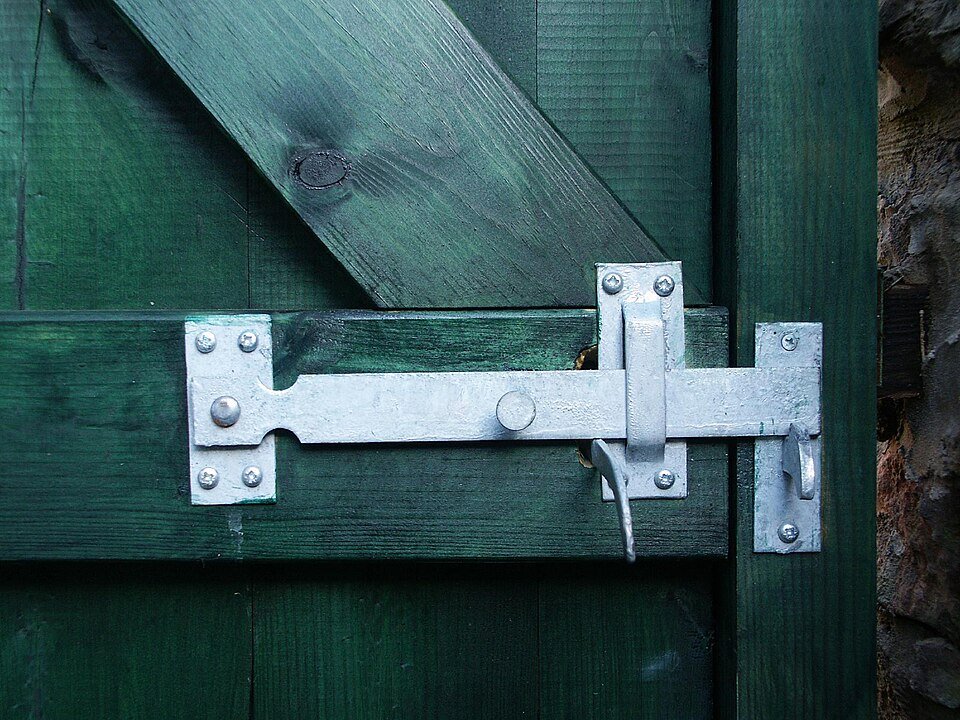
Cover photograph by Dave&Lynne Slater from Cumbria, United kingdom, CC BY 2.0, via Wikimedia Commons. Contextual image; not a selected product, test or certification of an installation.
