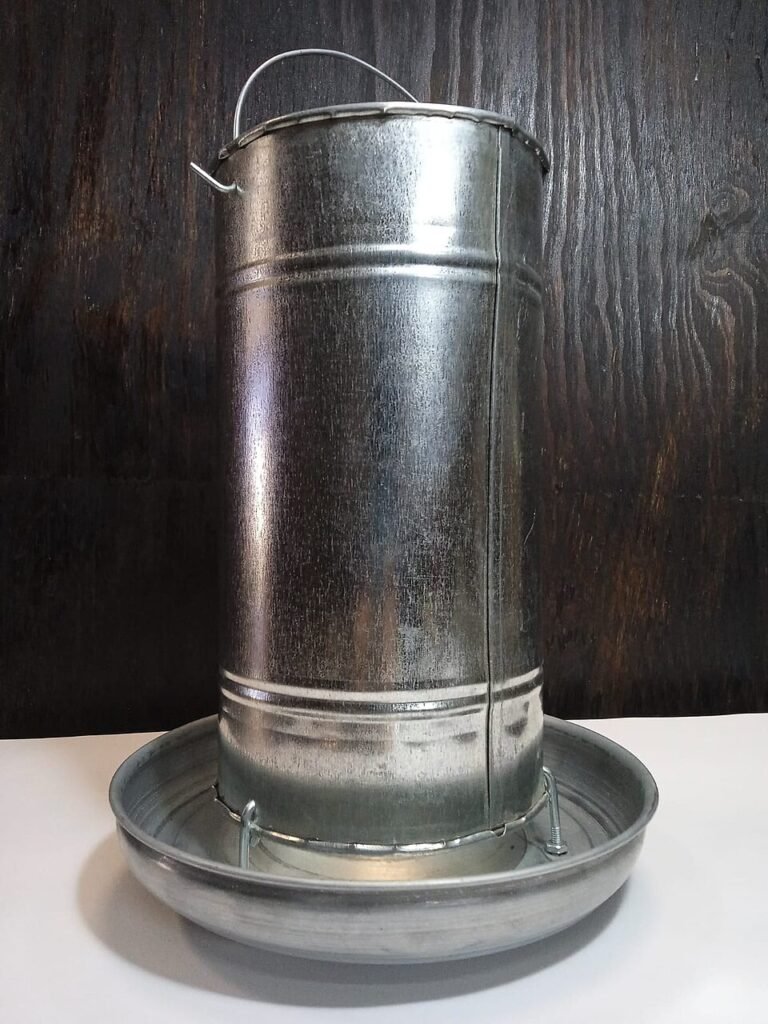
Allow about 2 to 3 linear inches of accessible feeder edge per adult chicken as a starting point, following Utah State University Extension’s small-flock guidance. Count only edge birds can actually reach. A hopper’s feed capacity, the number of holes in a bucket and the circumference of a blocked tray do not measure the same thing.
We may earn a commission when you buy through links on this page.
Calculate accessible edge before comparing hoppers
The Utah State feeding guide gives 2 to 3 linear inches per adult chicken and a different allowance for chicks. For 12 adults, that adult range works out to 24 to 36 inches of usable feeding edge. Treat it as a planning range, then observe whether the actual flock can obtain feed without persistent exclusion.
Write down the flock size and multiply by each end of the range. Keep the units beside the answer. Twelve birds multiplied by 3 inches gives 36 inches, not a 36-inch feeder of any design. The feeder’s arrangement determines whether one side, two sides or part of a circular edge is available.
Same trough, different available edge
These calculations concern adult chickens and accessible edge. They do not establish a feed ration, a growth target or a conversion rule for every port-style product. Our feeder comparison separates designs so you can check how birds reach the feed before comparing the amount stored above it.
Measure a trough on the sides birds can use
A straight trough placed against a wall normally offers access from the exposed side. Do not count the hidden side simply because the product has two edges. Check the usable length between end fittings or other obstacles, and include room for birds to stand along that edge rather than squeezing between the feeder and a partition.
As a hypothetical example, an 18-inch trough with both long sides fully accessible offers 36 inches of feeding edge. The same trough against a wall offers only 18 inches if the other side cannot be used. For the 12-adult planning example, those two placements produce very different results even though the hopper and purchase are identical.
End access is not automatically another full side. Count an end only if its design provides a usable feeding edge and there is room to approach it. Use the actual feeding opening, not the full exterior length of the container. Handles, closed corners or end guards may occupy part of that dimension.
Count a round feeder's exposed edge carefully
The geometric circumference of a circle is pi multiplied by its diameter. A fully accessible 12-inch-diameter feeding edge therefore has a circumference of about 37.7 inches. That is a geometry example, not a capacity claim for a particular feeder. Use the diameter of the actual feeding edge, not the hopper’s lid or outer rain cover.
If half that edge is blocked by a wall or another fixture, the theoretical circumference overstates the space birds can use. Also consider dividers and the standing area around the tray. An exposed arc is only useful if a bird can get into position beside it. Draw the feeder and nearby walls from above to see where the apparent space disappears.
Do not use circumference to certify a flock capacity by itself. A tray’s feed flow and arrangement can limit access, and individual birds may still be excluded. Penn State Extension discusses increasing feeder space as birds grow. Recheck the installation as your flock matures rather than treating an early setup as permanently adequate.
Treat ports and treadles as different access systems
A bucket with several ports does not provide one continuous trough edge. Birds use discrete openings, and the maker may specify suitable bird sizes, mounting height or how many birds a port arrangement is intended to serve. Read those instructions and observe the installed system. Do not multiply the diameter of each hole by the linear-inch guideline to invent a capacity.
A treadle feeder adds another step: a bird must operate the treadle and reach the opening. Check the maker’s minimum bird requirements, training instructions and approach space. The amount of feed stored behind the lid says nothing about whether a smaller flock member can open it or gain access when a dominant bird is standing there.
For either system, ask what happens during the busiest feeding period. Can more than one bird use it as intended? Is the approach clear? Are there birds waiting repeatedly without obtaining feed? A product’s suggested flock count is a starting question for your setup, not proof that every bird in your flock can use that installation.
Use more than one location when one becomes a bottleneck
First check that the existing feeding edge is actually available. Moving a feeder away from a wall can change access without increasing hopper size. If the flock still crowds one approach or particular birds are excluded, another appropriately placed feeder may offer a separate route to feed. Avoid putting both in the same narrow corner and assuming they function independently.
Plan the walking routes through the coop or run. A feeder across the entrance may interrupt access even if its tray has plenty of edge. Our coop-space guide separates enclosure area from equipment layout. More square footage can help create placement options, but it does not remove the need to inspect the feeding station itself.
Check water access at the same time. A useful feeding arrangement still needs a working, reachable drinking supply. The waterer comparison covers storage and outlet designs; do not let the feeder’s new location block the drinking point or crowd birds into a shared bottleneck.
Keep feed storage and feeding space on separate lines
Record hopper capacity as the amount of feed the unit can hold, using the maker’s stated units and any relevant feed-type limits. Record access as usable edge or the maker’s port/treadle requirements. A 20-pound hopper with one restricted approach can offer less practical access than a smaller unit with a well-positioned tray.
Decide how you will check, refill and clean the feeder. A large storage volume does not justify neglecting the feed’s condition or the working opening. Keep replacement feed dry and follow the supplier’s storage guidance. Do not assume a covered hopper excludes every pest or protects its contents under all weather conditions.
Before buying, put the feeder’s actual footprint on the plan described in our coop-equipment guide. Include the standing area around it and the room needed to open or remove components. The best capacity calculation is useful only if the installed feeder remains accessible to both flock and keeper.
Common questions
How much feeder space do 12 adult chickens need?
Using Utah State's 2-to-3-inch planning range gives 24 to 36 inches of accessible edge. Check the actual design and watch for exclusion; the calculation alone does not certify the installation.
Can I count both sides of a trough?
Count both long sides only if both provide usable feeding edge and birds can stand along them. A side against a wall is not accessible edge.
How do I convert feeder pounds into bird capacity?
Do not convert storage pounds into feeding space. Check the reservoir capacity and the usable feeding arrangement separately.
Cover photograph by ELTORO.VET, CC0, via Wikimedia Commons. Original planning diagram by Backyard Henhouse.
